
Key Takeaways
- Definition: The momentum equation relates an object’s mass and velocity to the amount of motion it carries.
- Main use: Engineers use momentum for impact, collision, impulse, vehicle motion, machinery, fluids, and first-pass dynamics checks.
- Watch for: Momentum is directional, so sign convention and vector direction matter just as much as the arithmetic.
- Outcome: After reading, you should be able to calculate momentum, rearrange the formula, and judge whether a result is physically reasonable.
Table of Contents
Reading a momentum equation example
The momentum equation relates mass and velocity, letting engineers calculate how much directed motion an object carries.
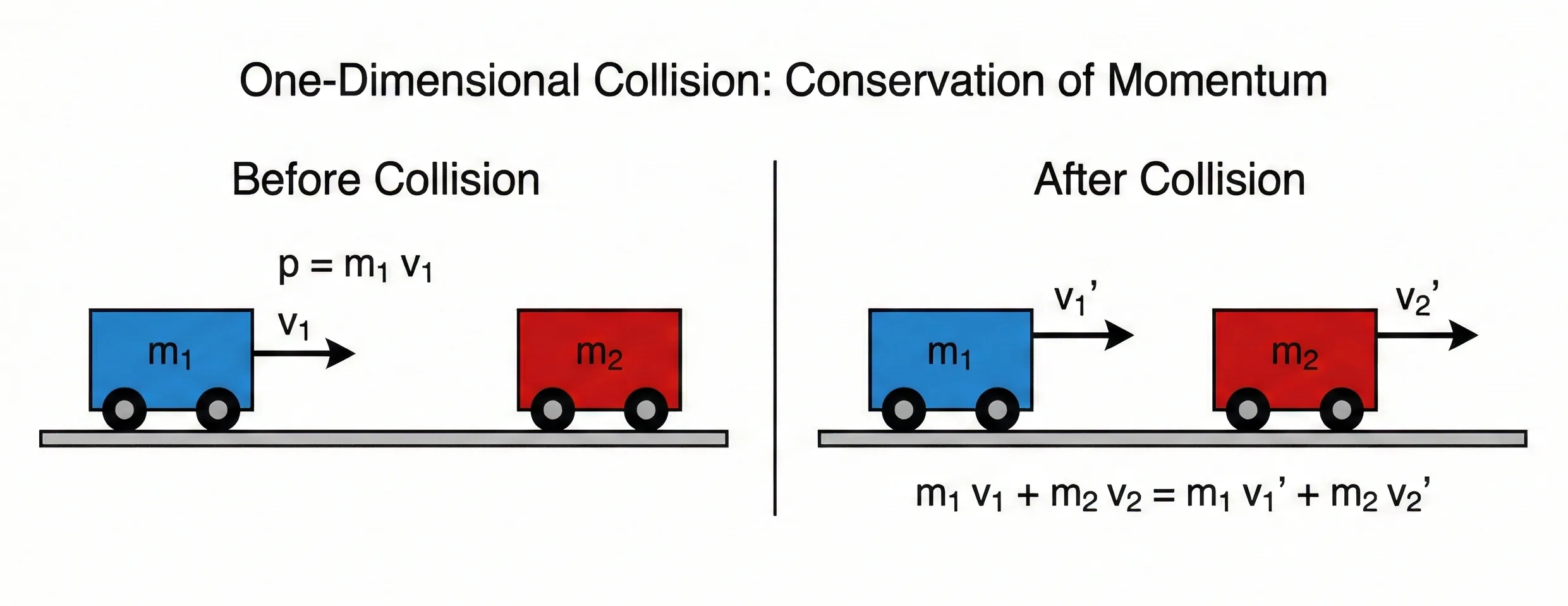
Notice that momentum is not just “speed.” A light object moving fast and a heavy object moving slowly can have similar momentum, but the way each behaves during stopping, impact, or direction change can be very different.
What is the momentum equation?
The momentum equation defines linear momentum as the product of mass and velocity. In engineering terms, it gives a compact way to describe how much motion an object has in a specific direction.
Momentum is useful because it connects directly to force and time. If an object’s momentum changes, some net force had to act over some time interval. That makes momentum important in vehicle impacts, machine components, sports equipment, robotics, fluid jets, crash barriers, and any system where motion changes quickly.
The basic formula is simple, but the engineering value comes from interpreting it correctly. Momentum is a vector quantity, so two objects can have the same momentum magnitude while moving in completely different directions.
The momentum equation formula
The most common form of the momentum equation is the linear momentum relationship. It applies to an object or particle moving with velocity \(v\) and mass \(m\).
In vector form, the same relationship is written with bold symbols to show that velocity and momentum have direction.
Physically, the equation says that momentum increases when mass increases, velocity increases, or both increase together. Doubling the mass doubles the momentum. Doubling the velocity also doubles the momentum.
Momentum is often the better first question when you care about changing motion. Kinetic energy is often the better first question when you care about work, stopping distance, or energy transfer.
Which momentum equation should you use?
Choose the relationship based on whether you need momentum, a momentum change, an impulse, or a collision balance.
| If you need | Use | Best for | Main caution |
|---|---|---|---|
| Momentum from mass and velocity | \(\mathbf{p}=m\mathbf{v}\) | Single-object motion | Momentum is a vector |
| Change in momentum | \(\Delta\mathbf{p}=\mathbf{p}_2-\mathbf{p}_1\) | Stopping, impacts, reversals | Keep signs and directions consistent |
| Impulse from force and time | \(\mathbf{J}=\int \mathbf{F}\,dt=\Delta\mathbf{p}\) | Short-duration forces | Force may vary with time |
| Collision balance | \(\sum \mathbf{p}_{before}=\sum \mathbf{p}_{after}\) | Isolated-system collisions | Requires negligible external impulse |
Variables and units
The momentum equation is unit-sensitive. The simplest SI form uses kilograms for mass and meters per second for velocity, producing momentum in kilogram-meters per second.
- \(p\) Linear momentum. In SI units, \(p\) is measured in \(\text{kg}\cdot\text{m/s}\), which is equivalent to \(\text{N}\cdot\text{s}\).
- \(m\) Mass of the object. In SI, use kilograms. In US customary calculations, be careful not to confuse mass units with force units.
- \(v\) Velocity of the object. Velocity includes direction, so positive and negative signs must match the chosen coordinate system.
| Variable | Meaning | SI units | US customary notes | Common issue |
|---|---|---|---|---|
| \(p\) | Linear momentum | \(\text{kg}\cdot\text{m/s}\) or \(\text{N}\cdot\text{s}\) | Can be expressed using consistent slug-ft/s units | Treating momentum as a scalar when direction matters |
| \(m\) | Mass | \(\text{kg}\) | Use slugs for consistent dynamics calculations | Using pounds-force as if it were mass |
| \(v\) | Velocity | \(\text{m/s}\) | \(\text{ft/s}\) when paired with slugs | Using speed without checking direction |
In SI, \(\text{kg}\cdot\text{m/s}\) and \(\text{N}\cdot\text{s}\) are equivalent momentum units because one newton equals \(1\ \text{kg}\cdot\text{m/s}^2\).
A \(1\ \text{kg}\) object moving at \(1\ \text{m/s}\) has \(1\ \text{kg}\cdot\text{m/s}\) of momentum. Use that as a simple reference point before trusting larger calculations.
How to rearrange the momentum equation
Engineers usually rearrange the momentum equation when they know two quantities and need the third. The algebra is simple, but the units and direction convention still need to stay consistent.
Use this form when momentum and mass are known and you want the object’s velocity.
Use this form when momentum and velocity are known and you want the mass associated with that motion.
If velocity is negative because of your coordinate direction, momentum should also carry that sign. Do not drop the sign unless you intentionally want only the magnitude.
Impulse and change in momentum
Impulse is the accumulated effect of force over time. It equals the change in momentum:
If force is approximately constant during the interval:
The same momentum change can be produced by a large force acting briefly or a smaller force acting for a longer time. That is why stopping time and deformation strongly affect peak impact force.
Where the momentum equation comes from
Momentum is closely tied to Newton’s laws of motion. Newton’s second law can be written as force equals the rate of change of momentum. For constant mass systems, that relationship reduces to the familiar \(F = ma\).
If mass is constant, then \(\mathbf{p} = m\mathbf{v}\), so changing velocity changes momentum. This is why a larger force, a longer force duration, or both can create a larger change in motion.
The impulse relation is the next step after the basic momentum equation. It is especially useful for impacts, collisions, hammer blows, braking events, and other short-duration force problems.
Conservation of momentum
For a system with negligible external impulse over the interval, total linear momentum is conserved:
In one dimension for two bodies:
Momentum conservation applies to elastic and inelastic collisions, but kinetic energy is conserved only in an ideal elastic collision.
Do not assume kinetic energy is conserved just because momentum is conserved. Real collisions can dissipate energy through deformation, heat, sound, fracture, and internal motion.
Where engineers use the momentum equation
The momentum equation is most useful when an engineering problem involves motion that changes because of a force, impact, collision, or flow redirection.
- Vehicle and crash analysis: estimating how mass and speed affect impact severity, barrier loading, and post-impact motion.
- Machine design: checking moving parts, rotating assemblies, actuators, and equipment stops where moving mass must be slowed or redirected.
- Fluid mechanics: applying momentum balance to jets, pipe bends, nozzles, turbines, and control volumes.
- Robotics and mechatronics: sizing motors, stops, and control responses for moving links or payloads.
- Exam-style dynamics problems: solving particle motion, collision, impulse, and conservation-of-momentum problems.
Momentum calculations often look clean on paper, but real systems include friction, deformation, damping, control lag, contact stiffness, and uncertain impact duration.
Worked example
Example problem
A \(75\ \text{kg}\) equipment cart is rolling in a straight line at \(2.4\ \text{m/s}\). Find the cart’s linear momentum.
Substitute the known mass and velocity into the equation.
Multiply the values and keep the units attached.
The cart has \(180\ \text{kg}\cdot\text{m/s}\) of momentum in the direction it is moving. If the cart must be stopped, a force must act long enough to reduce that momentum to zero.
Example problem — stopping force from momentum change
A \(20\ \text{kg}\) cart moving at \(3.0\ \text{m/s}\) is brought to rest in \(0.50\ \text{s}\). Estimate the average stopping force.
The average stopping force is \(120\ \text{N}\) opposite the direction of motion. The actual peak force could be higher if the force varies during contact.
The answer is not just a number. It tells you the motion that must be removed, redirected, or absorbed by braking, impact, friction, or another external force.
Momentum equation in fluid mechanics
Fluid mechanics uses a control-volume momentum balance rather than only the particle form \(p=mv\). For steady one-inlet, one-outlet flow, a simplified vector form is:
This relationship is used to estimate forces on pipe bends, nozzles, jets, vanes, and other devices that change fluid velocity or direction.
Pressure forces, gravity, support reactions, multiple inlets or outlets, and unsteady accumulation may also belong in the full momentum balance. Define the control volume before writing the force equation.
When the basic momentum model is not enough
The basic momentum equation \(p = mv\) is broadly useful, but it is only the starting point for many real engineering problems. The more important question is often whether mass, velocity, and direction are defined clearly enough for the equation to represent the actual system.
- 1 The mass being analyzed is clearly defined and does not change during the calculation.
- 2 Velocity is measured relative to a defined reference frame.
- 3 The direction convention is consistent from setup through final answer.
- 4 External forces, deformation, and energy losses are handled separately when they matter.
Neglected factors
The simple momentum equation does not by itself account for friction, drag, deformation, heat generation, sound, rebound behavior, fluid turbulence, or structural damage. Those effects may control the design even when the momentum calculation is correct.
Do not use \(p = mv\) alone as a crash, impact, or safety design method. Momentum is necessary for understanding the motion change, but force levels depend on stopping time, deformation, stiffness, and load path.
Momentum vs. kinetic energy
Momentum and kinetic energy both describe motion, but they answer different engineering questions.
| Quantity | Equation | Velocity dependence | Best used for |
|---|---|---|---|
| Momentum | \(\mathbf{p}=m\mathbf{v}\) | Linear in velocity | Impulse, collisions, motion change, force-time problems |
| Kinetic energy | \(KE=\frac12mv^2\) | Velocity squared | Work, stopping distance, energy absorption, deformation |
If you care about how motion changes through an interaction, momentum is often the right first tool. If you care about work, stopping distance, or absorbed energy, kinetic energy is often more useful.
Common mistakes and engineering checks
Most momentum errors come from units, signs, or using momentum when another quantity is actually being asked for.
- Using pounds-force as mass without converting to slugs in US customary dynamics work.
- Ignoring direction and treating all momentum values as positive scalar quantities.
- Confusing momentum \(p = mv\) with kinetic energy \(KE = \frac{1}{2}mv^2\).
- Using speed when the problem requires velocity along a defined axis.
- Assuming equal momentum means equal damage, even though damage depends strongly on energy, stiffness, deformation, and contact time.
| Check item | What to verify | Why it matters |
|---|---|---|
| Units | Mass and velocity are in compatible units | Prevents incorrect momentum magnitude |
| Direction | Positive and negative signs match the coordinate system | Momentum is a vector, not just a number |
| Purpose | The problem asks for motion quantity, not energy or stopping distance | Momentum and kinetic energy answer different engineering questions |
| System boundary | The object or control volume is clearly defined | Momentum balance depends on what is included in the system |
If velocity doubles and mass stays constant, momentum should double. If your result changes by velocity squared, you are probably calculating kinetic energy instead.
Frequently asked questions
The momentum equation is \(p = mv\), where \(p\) is momentum, \(m\) is mass, and \(v\) is velocity. It describes the amount of directed motion an object carries.
In SI calculations, use kilograms for mass and meters per second for velocity. The resulting momentum unit is \(\text{kg}\cdot\text{m/s}\), which is equivalent to \(\text{N}\cdot\text{s}\).
From \(p = mv\), solve for velocity using \(v = p/m\) or solve for mass using \(m = p/v\). Keep units consistent and preserve direction signs when velocity is directional.
No. Momentum is \(p = mv\), while kinetic energy is \(KE = \frac{1}{2}mv^2\). Momentum is directional and linear with velocity. Kinetic energy is scalar and increases with velocity squared.
Summary and next steps
The momentum equation \(p = mv\) is one of the core relationships in engineering dynamics. It combines mass and velocity into a directional measure of motion, making it useful for impact, impulse, collision, machinery, robotics, vehicle, and fluid-flow problems.
The key is to treat momentum as a vector quantity, keep units consistent, and avoid confusing momentum with kinetic energy. In real engineering work, momentum often starts the analysis, but stopping force, deformation, stiffness, contact time, and energy loss determine the final design implications.
Where to go next
Continue your learning path with these curated next steps.
-
Foundation: Newton’s Second Law
Connect net force directly to the rate of momentum change.
-
Related: Kinetic Energy Equation
Compare momentum-based motion change with energy-based work and stopping calculations.
-
Tool: Momentum Calculator
Calculate momentum quickly from mass and velocity inputs.