
Key Takeaways
- Definition: Newton’s Second Law states that the net external force on a body equals its mass times acceleration: \(\sum \mathbf{F}=m\mathbf{a}\).
- Main use: Use it to solve for force, mass, or acceleration after identifying all external forces and choosing a coordinate system.
- Watch for: The familiar \(F=ma\) form assumes constant mass; variable-mass systems require the more general momentum equation.
- Outcome: You will be able to build a force balance, solve one- and two-dimensional dynamics problems, and recognize when a different mechanics method is more appropriate.
Table of Contents
From forces to acceleration
Newton’s Second Law connects the external forces acting on a body to the acceleration that results. A free-body diagram is usually the best starting point because the equation uses the net force, not just one applied load.
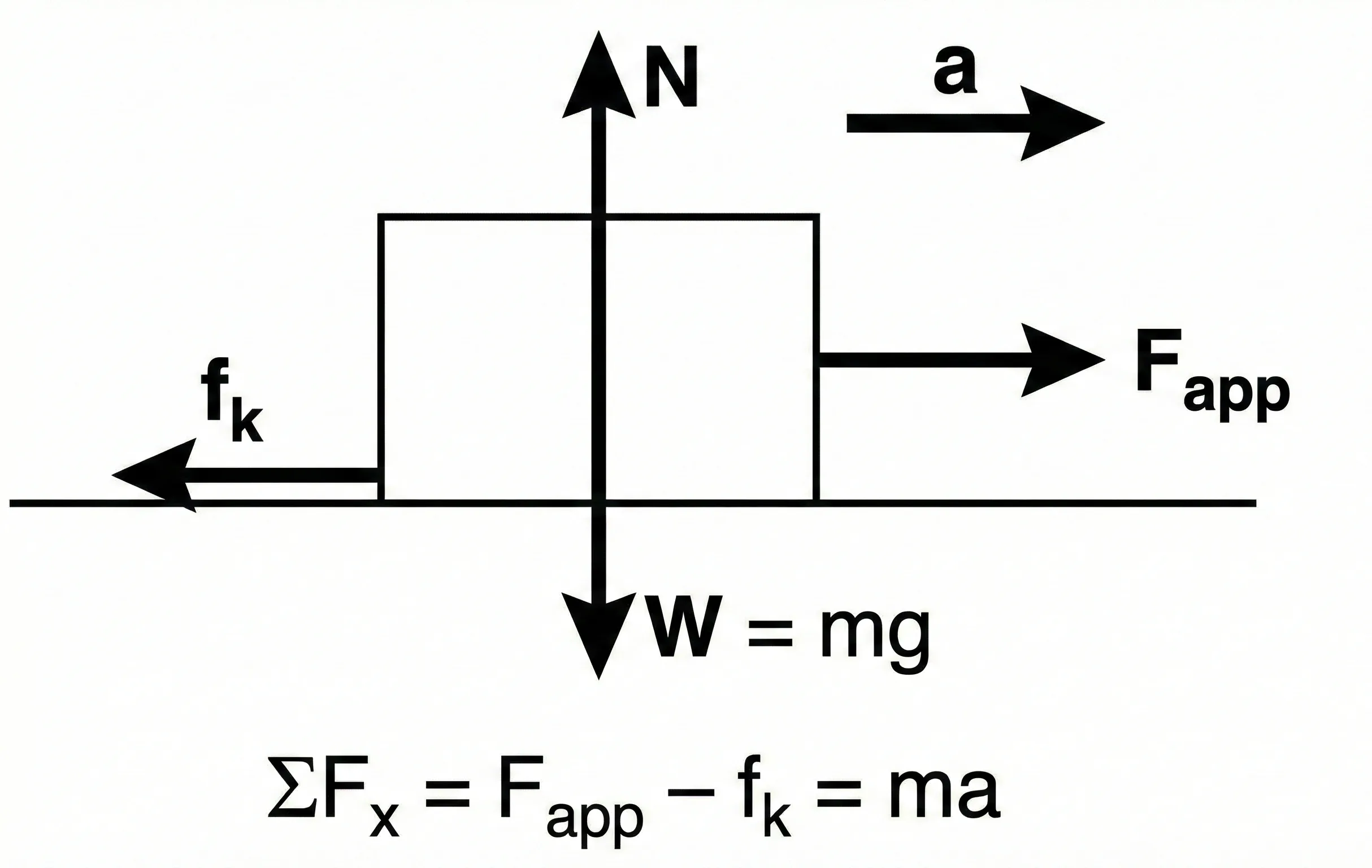
The most important modeling step is to include every external force that acts on the chosen system and then resolve those forces along consistent axes.
What is Newton’s Second Law?
Newton’s Second Law states that the net external force on an object equals its mass times its acceleration. In its most common engineering form, \(\sum F=ma\), so the required net force can be found from mass and acceleration, or acceleration can be found from the net force and mass.
In introductory physics and most engineering dynamics problems, this form works when the body’s mass is constant and all forces are summed using a consistent sign convention or coordinate system.
More generally, Newton’s Second Law comes from the momentum relation \(\sum \mathbf{F}=\dfrac{d\mathbf{p}}{dt}\). The familiar \(F=ma\) expression is therefore a special case of the general momentum equation when mass does not change.
The Newton’s Second Law formula
The vector form used in engineering mechanics is:
The left side is the vector sum of all external forces acting on the body. The right side is mass multiplied by the body’s acceleration vector.
For two-dimensional motion, solve the force balance by components:
For variable-mass systems, return to the more general momentum relation:
Do not substitute a single applied force for \(\sum F\) unless it is actually the net force. Friction, drag, weight, support reactions, tension, and other external loads must be accounted for first.
Which Newton’s Second Law equation should you use?
Choose the form based on the system and the unknown you need to solve.
| Problem type | Use | Best for | Main caution |
|---|---|---|---|
| Constant-mass particle/body | \(\sum \mathbf{F}=m\mathbf{a}\) | Most dynamics problems | Use net external force, not one applied force |
| 2D motion | \(\sum F_x=ma_x,\ \sum F_y=ma_y\) | Inclines, friction, projectiles with forces | Resolve every force into consistent axes |
| Static equilibrium | \(\sum \mathbf{F}=0\) | Zero-acceleration special case | Equilibrium is a special case of Newton’s Second Law |
| Variable-mass system | \(\sum \mathbf{F}=d\mathbf{p}/dt\) | Mass flow or changing-mass problems | System boundary and momentum flux matter |
Variables and units
Before solving a dynamics problem, define the system, draw the free-body diagram, choose the coordinate directions, and keep units consistent.
- \(\sum F\) Net external force acting on the body. Unit: newtons (N).
- \(m\) Mass of the body. Unit: kilograms (kg).
- \(a\) Acceleration of the body. Unit: meters per second squared (m/s²).
- \(W\) Weight or gravitational force, commonly \(W=mg\). Unit: newtons (N).
- \(N\) Normal force exerted by a surface perpendicular to contact. Unit: newtons (N).
- \(f\) Friction force opposing relative or impending motion. Unit: newtons (N).
- \(T\) Tension force transmitted through a cable, rope, or connector. Unit: newtons (N).
| Symbol | Meaning | Typical unit | Engineering note |
|---|---|---|---|
| \(\sum F\) | Net force | N | Vector sum of all external forces acting on the object. |
| \(m\) | Mass | kg | Mass is not the same as weight. |
| \(a\) | Acceleration | m/s² | Directional quantity; sign convention matters. |
| \(W\) | Weight | N | Commonly calculated from \(W=mg\). |
| \(N\) | Normal force | N | Acts perpendicular to the contact surface. |
| \(f\) | Friction force | N | Often modeled using \(f_k=\mu_k N\) during sliding. |
| \(T\) | Tension | N | Acts along a cable or rope and pulls away from the body. |
One newton is \(1\,\text{kg}\cdot\text{m}/\text{s}^2\). If force is in newtons and mass is in kilograms, acceleration will come out in m/s².
How to draw a free-body diagram
A free-body diagram isolates the chosen body and shows only the external forces acting on it. It is usually the most important step in a Newton’s Second Law problem.
- 1 Choose the system boundary before drawing forces.
- 2 Show weight, normal force, friction, tension, applied forces, drag, or other external loads as applicable.
- 3 Do not include internal forces between parts that are both inside the selected system.
- 4 Choose coordinate axes that simplify the force components, especially for inclined planes.
Do not draw \(ma\) as an extra force on an ordinary inertial-frame free-body diagram. \(m\mathbf{a}\) is the result of the net external force, not another physical force acting on the body.
How to rearrange Newton’s Second Law
For a constant-mass body, Newton’s Second Law can be rearranged to solve for the unknown force, mass, or acceleration.
The computed acceleration should point in the same direction as the net force. If it does not, revisit the sign convention or the force balance.
Newton’s Second Law on an inclined plane
For a block on an incline of angle \(\theta\), it is usually easiest to align one axis parallel to the slope and one axis normal to it.
If there is no acceleration normal to the surface and no other normal-direction force:
With kinetic friction opposing downhill motion:
Aligning an axis with the slope usually avoids unnecessary trigonometric components for the normal force and acceleration.
How Newton’s Second Law works in engineering problems
The most reliable way to use Newton’s Second Law is as a process rather than a memorized formula. In practical mechanics, the correct answer usually depends more on identifying the net force correctly than on the algebra itself.
- 1 Identify the system: choose the body or collection of bodies being analyzed.
- 2 Draw the free-body diagram: isolate the system and show every external force.
- 3 Choose coordinates: align axes with the motion or geometry, such as along an incline.
- 4 Sum forces by axis: write equations such as \(\sum F_x=ma_x\) and \(\sum F_y=ma_y\).
- 5 Solve and check: substitute values, solve the algebra, then verify sign, direction, and units.
Friction and tension
Engineering systems rarely involve only one applied force. Friction and tension often dominate the setup. A common kinetic-friction model is:
Tension acts along a cable or rope and usually points away from the body being analyzed. Including these forces correctly is what turns Newton’s Second Law from a classroom formula into a usable engineering tool.
The free-body diagram is often the real engine of the solution. A correct equation with a missing force is still a wrong model.
Connected bodies and tension
When bodies are connected by an ideal rope or cable, each body gets its own free-body diagram, but the acceleration constraint links the equations.
Once the system acceleration is known, apply Newton’s Second Law to either body to solve for the internal cable tension.
Treating connected bodies as one combined system can eliminate internal tension from the first equation, making the acceleration easier to solve.
Worked examples using Newton’s Second Law
Example 1: find acceleration from a known net force
Scenario: A \(10\,\text{kg}\) cart is pulled with a net horizontal force of \(35\,\text{N}\). Find the acceleration.
Result: The cart accelerates at \(3.5\,\text{m/s}^2\) in the direction of the net force.
Example 2: find the force needed for a target acceleration
Scenario: A machine component with mass \(22\,\text{kg}\) must accelerate at \(1.8\,\text{m/s}^2\). Find the required net force.
Result: The required net force is \(39.6\,\text{N}\). If friction or drag is present, the applied force must be greater than this net-force requirement.
Example 3: block with kinetic friction
Scenario: A \(15\,\text{kg}\) block is pushed with \(80\,\text{N}\). Kinetic friction opposing motion is \(26\,\text{N}\). Find acceleration.
Result: The block accelerates at \(3.6\,\text{m/s}^2\). The correct result comes from the net force, not the \(80\,\text{N}\) push alone.
Example 4: block sliding down an incline
Scenario: A \(12\,\text{kg}\) block slides down a \(25^\circ\) incline with \(\mu_k=0.15\). Find its acceleration, neglecting air resistance.
Result: The block accelerates down the incline at about \(2.8\,\text{m/s}^2\). Mass cancels because both gravity and friction scale with \(m\) in this simplified model.
Assumptions and limitations
The familiar \(\sum F=ma\) form is ideal for constant-mass bodies and particle dynamics. It is less complete when mass changes, when forces act over very short impact intervals, or when material or fluid crosses the system boundary.
- 1 The mass of the analyzed body is effectively constant.
- 2 The system boundary is clearly defined so external forces can be identified.
- 3 Forces and acceleration are resolved using the same coordinate system.
- 4 The chosen mechanics model is appropriate for the time scale and type of loading.
When \(F=ma\) alone is not enough
For rockets, some conveyor systems, or other variable-mass cases, use the general momentum equation. For short-duration impacts, impulse-momentum methods may be more appropriate. Fluid control volumes also require momentum formulations that account for mass flow.
Do not apply the constant-mass shortcut blindly to a changing-mass system. Return to \(\sum \mathbf{F}=d(m\mathbf{v})/dt\) when mass enters or leaves the system.
Common mistakes and engineering checks
- Using applied force instead of net force: friction, reactions, drag, weight, and other loads must be included.
- Confusing mass with weight: mass is in kilograms; weight is a force in newtons and is commonly \(W=mg\).
- Ignoring direction: force and acceleration are vectors, so signs and component directions matter.
- Skipping the system boundary: whether a force is internal or external depends on what is included in the system.
- Using \(F=ma\) for variable mass: changing-mass systems require the general momentum relation.
If the net force points right, the acceleration should not point left unless your coordinate sign convention explicitly represents that direction as negative.
| Check item | What to verify | Why it matters |
|---|---|---|
| Net force | All external forces are included | Prevents using one applied force as the full force balance |
| Mass vs. weight | Mass in kg; weight in N | Prevents dimensional and physical errors |
| Coordinates | Forces and acceleration use the same axes | Keeps signs and components consistent |
| System boundary | Internal and external forces are identified correctly | Critical for multi-body and connected systems |
References and further reading
Frequently asked questions
It states that the net force on an object equals its mass times its acceleration. Stronger net forces create greater acceleration, while larger masses require more force to achieve the same acceleration.
The most common form is \(\sum F=ma\), where \(\sum F\) is net force, \(m\) is mass, and \(a\) is acceleration.
If net force stays the same and mass is doubled, acceleration is cut in half because \(a=\sum F/m\).
It depends on the system boundary. If the Earth is outside the chosen system, gravity is external. If the Earth and object are treated as one combined system, gravity can be internal to that larger system.
Summary and next steps
Newton’s Second Law is the core dynamics relationship between external force and acceleration. For constant mass, use \(\sum \mathbf{F}=m\mathbf{a}\), build the free-body diagram first, and solve the force balance along consistent coordinate axes.
The most important engineering judgment is knowing what belongs in the force balance and when the constant-mass form is no longer sufficient. Variable mass, impacts, and mass-flow problems may require momentum-based methods instead.
Where to go next
Continue with these related mechanics and engineering resources.
-
Prerequisite: Acceleration Formula
Review motion and acceleration before applying a force balance.
-
Related: Momentum Equation
Extend Newton’s Second Law into impulse, momentum change, and variable-mass systems.
-
Alternative method: Kinetic Energy Equation
Use energy methods when work and displacement are more convenient than acceleration.