
Key Takeaways
- Definition: A mat foundation is a large reinforced concrete slab that supports multiple columns or walls and spreads structural load across one broad footprint.
- Use case: Mats are often chosen when individual footings would overlap, soil support is moderate to weak, or differential settlement control matters more than local bearing alone.
- Main decision: The core question is whether a shallow, area-wide load transfer system can meet bearing, settlement, structural, and groundwater demands more efficiently than separate footings or piles.
- Outcome: After reading, you should understand how mat foundations work, what usually controls design, and when they stop being the right solution.
Table of Contents
Introduction
In brief: Mat foundations are large slabs that distribute building loads over a wide area to control soil pressure and reduce differential settlement.
Who it’s for: Students, FE/PE prep, and designers.
For informational purposes only. See Terms and Conditions.
A mat foundation is not just a “big footing.” It is a system-level choice that blends geotechnical behavior, structural stiffness, groundwater conditions, and construction practicality.
Mat Foundations infographic
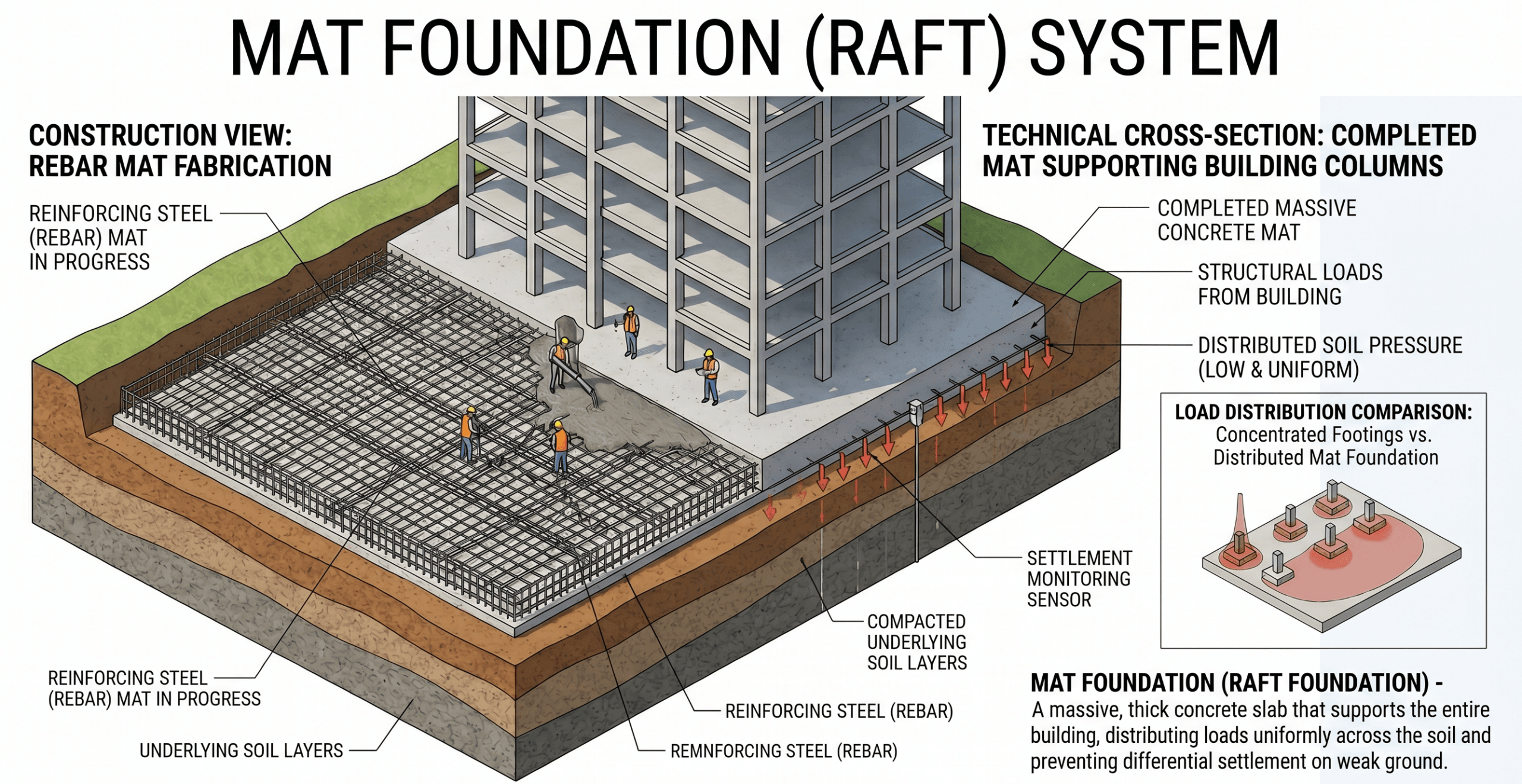
Notice first how the slab links many columns together. That matters because the geotechnical problem is no longer only local bearing beneath one support; it becomes a broader question of average stress, stiffness compatibility, and differential movement across the entire footprint.
What are Mat Foundations?
Mat foundations, also called raft foundations in many references, are shallow foundation systems consisting of one large reinforced concrete slab supporting multiple columns, walls, or both. Instead of sending loads into the ground through isolated pads, the mat spreads them across a much larger area. That wider footprint lowers average bearing pressure and helps the building respond more uniformly to variable soil support.
Engineers commonly consider a mat when column spacing is tight, column loads are heavy, basement construction already requires a slab, or serviceability limits make differential settlement a bigger concern than ultimate bearing failure. In practice, mat foundations sit at the intersection of foundation design, soil stiffness interpretation, and structural slab behavior.
A good mat foundation does not simply “pass bearing.” It must also control settlement, resist punching and flexure, accommodate groundwater and uplift, remain buildable, and match the true subsurface conditions identified during geotechnical engineering investigation and design.
Core principles, variables, and units
The geotechnical behavior of a mat foundation is driven by how load, area, soil stiffness, and slab stiffness interact. A wider mat generally reduces average contact pressure, but it does not guarantee acceptable settlement. Soft layers at depth, groundwater, stress history, and load concentration can still control performance.
Key variables and typical ranges
Most early mat sizing discussions revolve around footprint area, net contact pressure, total load, and estimated settlement. Structural design then adds slab thickness, reinforcement demands, punching shear checks, and stiffness compatibility with the superstructure.
- Q Total service or factored structural load, usually in kips or kN, including column, wall, and slab self-weight as applicable.
- A Mat plan area in ft² or m²; larger area generally lowers average bearing pressure.
- q Average contact pressure in psf, ksf, kPa, or MPa, commonly estimated as load divided by effective loaded area.
- s Settlement, usually tracked as total and differential movement in inches or millimeters.
- k_s Subgrade reaction or equivalent support parameter used in some structural idealizations; useful, but never a substitute for full geotechnical judgment.
Do not confuse low average bearing pressure with low risk. A mat can still perform poorly if compressible layers extend deep enough to drive unacceptable total or differential settlement.
When engineers choose a mat foundation
The decision to use a mat is usually driven by geometry, movement tolerance, and constructability. It is rarely just a single bearing-capacity calculation.
Start with the structure: are column loads heavy, closely spaced, or wall lines dense enough that isolated or strip footings become inefficient? Then check the ground: can near-surface soil support the building with acceptable total and differential settlement? If yes, compare a mat against alternatives such as strip foundations, combined foundations, ground improvement, or pile foundations. If basement construction, waterproofing strategy, and excavation logistics favor one large slab, a mat often becomes the more coherent solution.
In many buildings, the “why mat?” answer is economic as much as technical. Ten oversized footings with complicated overlaps, grade beams, and variable settlements can be harder to build and coordinate than one integrated slab. But that economy disappears quickly if the soil profile is too compressible or if uplift, heave, or groundwater control become dominant risks.
Equations and calculations
Early geotechnical screening often starts with average contact pressure. This is not the full design, but it helps determine whether a mat is plausible before more detailed soil-structure interaction modeling is performed.
Here, \( q_{avg} \) is the average contact pressure, \( Q \) is the applied load, and \( A \) is the effective loaded area of the mat. At a minimum, engineers compare this pressure against allowable or limit-state support criteria and then evaluate settlement using soil compressibility and stress distribution beneath the mat.
Net pressure is often more meaningful than gross pressure because excavation removes overburden while the mat adds self-weight back. Depending on the project, you may also need to include basement effects, hydrostatic uplift, construction staging loads, and load combinations from the structural model.
For serviceability, the settlement question is often more important than the pressure question. That is why mat foundations are frequently evaluated alongside settlement analysis rather than as a stand-alone bearing check.
Worked example
Example
Suppose a mid-rise building transfers a total service load of 24,000 kips to a planned basement mat measuring 120 ft by 90 ft. The plan area is 10,800 ft², so the average gross contact pressure is approximately \( 24{,}000 / 10{,}800 = 2.22 \) ksf. At first glance, that may appear acceptable for medium-dense granular soil or stiff clay, but that is only the starting point.
The geotechnical engineer then asks the more important questions. Are there soft clay layers below the founding elevation? How much of the original overburden is removed for the basement excavation? Are column loads heavily concentrated toward the core? Will the slab stiffness redistribute contact pressure enough to reduce edge or interior peaks? Could long-term consolidation still push differential settlement past structural tolerances?
If the soil profile shows dense sand over very compressible clay, the mat may still be a poor solution even though the average pressure seems reasonable. If instead the excavation removes substantial overburden and the remaining profile is stiff and relatively uniform, the mat may perform well and also simplify the basement structure. That is the real lesson: mat foundation design is a system decision, not a one-line division problem.
Engineering judgment and field reality
In the field, mat foundations succeed or fail on the quality of the ground model. Boreholes can miss soft pockets, desiccated crust can hide weaker material below, and groundwater behavior can change once excavation opens the site. Even a well-proportioned slab can underperform if the founding surface is disturbed, softened by weather, or inadequately proof-rolled and prepared.
Another field reality is that mats magnify coordination issues. Waterproofing, under-slab drainage, embedded utilities, elevator pits, thickened zones, and sequencing around deep excavations can all influence the final performance. Structural and geotechnical assumptions must line up with what is actually built.
The founding surface matters more than many teams expect. A great design can lose performance quickly if excavation leaves softened bearing zones, poorly compacted replacement fill, or unaddressed seepage at the base.
When this breaks down
Mat foundations stop being the best answer when the soil problem is too deep, too variable, or too movement-sensitive for a shallow area foundation to solve efficiently. Common breakdown cases include thick deposits of normally consolidated clay, peat, loose uncontrolled fill, severe collapsible soils, aggressive uplift conditions, or highly variable support across the footprint.
They also become less attractive when the structure has extremely tight settlement tolerances, such as vibration-sensitive equipment, high-rise cores with strict differential movement limits, or neighboring structures that cannot tolerate excavation-related movement. In those cases, a piled raft, deep foundation system, or ground improvement program may be more reliable.
One more breakdown point is analytical oversimplification. If a project truly depends on soil-structure interaction, relying only on uniform pressure assumptions or one generic modulus can create false confidence. The more the project depends on stiffness compatibility, the more careful the modeling and interpretation need to be.
Common pitfalls and engineering checks
- Using average pressure as if contact pressure were actually uniform beneath the entire mat.
- Ignoring differential settlement because the total settlement number looks modest.
- Forgetting that basement excavation changes net foundation pressure.
- Checking geotechnical bearing but underestimating structural punching or flexure demands.
- Assuming groundwater can be managed easily without verifying uplift and waterproofing strategy.
A frequent mistake is selecting a mat simply because many footings overlap on plan, without proving that long-term settlement and stiffness compatibility are acceptable for the real soil profile.
| Check | Main concern | Typical units | What it tells you |
|---|---|---|---|
| Average / net pressure | Overall soil demand | ksf, psf, kPa | Whether the mat is broadly plausible as a shallow support system. |
| Total settlement | Global movement | in, mm | Whether the structure can tolerate the overall downward movement. |
| Differential settlement | Relative distortion | in, mm, angular distortion | Often the serviceability check that controls cracking and alignment risk. |
| Punching shear | Local slab failure | stress or strength ratio | Whether concentrated column loads can be transferred safely through the slab. |
| Uplift / groundwater | Buoyancy and seepage | psf, kPa, safety ratio | Whether the mat and basement system remain stable below grade. |
Ask what really controls the design: bearing, total settlement, differential settlement, punching, uplift, or construction sequencing. The right answer is often not the first calculation on the page.
Relevant standards and design references
Mat foundation design is shaped by both geotechnical and structural references. The exact governing standard depends on project type, jurisdiction, and material system, but these are the references engineers commonly connect back to:
- IBC and local building code adoption: Establishes the legal framework for foundation design, loads, and geotechnical reporting requirements.
- ACI 318: Governs reinforced concrete strength design, including slab flexure, shear, punching, detailing, and load combinations used for the mat itself.
- ASCE 7: Provides gravity, lateral, and load combination requirements that feed the foundation demand side of the design.
- Project geotechnical report and subsurface exploration standards: These define the soil profile, groundwater conditions, allowable or limit-state support criteria, and settlement assumptions behind the geotechnical design.
- Owner, agency, or basement waterproofing criteria: Often control uplift resistance, under-slab drainage, and long-term durability details that are easy to underweight early in design.
Frequently asked questions
Usually no. In most engineering usage, mat foundation and raft foundation describe the same concept: one large slab supporting multiple columns or walls over a broad area.
They often make more sense when footing areas overlap, loads are concentrated, a basement slab is already needed, or differential settlement control is more important than treating each support independently.
The controlling issue is often serviceability rather than ultimate bearing alone, especially differential settlement, but punching shear, flexure, uplift, and groundwater can also govern depending on the project.
They become less effective where weak or compressible layers extend too deep, groundwater creates severe uplift or construction problems, or settlement tolerances are too strict for a shallow area foundation to satisfy.
Summary and next steps
Mat foundations are large-area shallow foundations used to spread load, simplify support across many columns or walls, and improve settlement performance compared with separate footings in the right soil conditions. Their value comes from system behavior: one slab, one footprint, and a better chance of controlling differential movement where isolated supports would compete with one another.
The best mat designs are driven by what actually controls the project. Sometimes that is net pressure. Often it is settlement. On many real jobs it is a combination of structural slab behavior, groundwater, excavation effects, and the true variability of the subsurface profile. That is why good mat foundation design depends as much on engineering judgment and coordination as on equations.
Keep the big picture in mind: a mat is strongest when it matches both the structure and the ground. If the soil problem is too deep or too compressible, forcing a mat can cost more later than choosing a deeper or hybrid system earlier.
Where to go next
Continue your learning path with these curated next steps.
-
Read a deeper dive on Foundation Design
See how mat foundations fit into the broader process of selecting and proportioning shallow and deep support systems.
-
Study Settlement Analysis
Useful when the next step is checking whether the mat can meet total and differential movement limits.
-
Compare with Pile Foundations
A strong next step when shallow support becomes less reliable than load transfer to deeper competent strata.