
Key Takeaways
- Core idea: Gas laws describe how pressure, volume, temperature, and amount of gas are related.
- Engineering use: Engineers use gas laws to model air compressors, tanks, pistons, HVAC air systems, engines, pressure vessels, and thermodynamic processes.
- What controls it: The correct equation depends on which properties change and which properties are held constant.
- Practical check: Use absolute pressure, absolute temperature, consistent units, and ideal-gas assumptions that fit the gas and operating range.
Table of Contents
Introduction
Gas laws are relationships that describe how gas pressure, volume, temperature, and amount change together. In thermodynamics, they help engineers estimate gas states in tanks, piston-cylinder systems, compressors, HVAC air systems, engines, and pressure vessels where gas behavior affects force, work, heat transfer, density, mass flow, or equipment safety.
Gas Laws Formula Chart
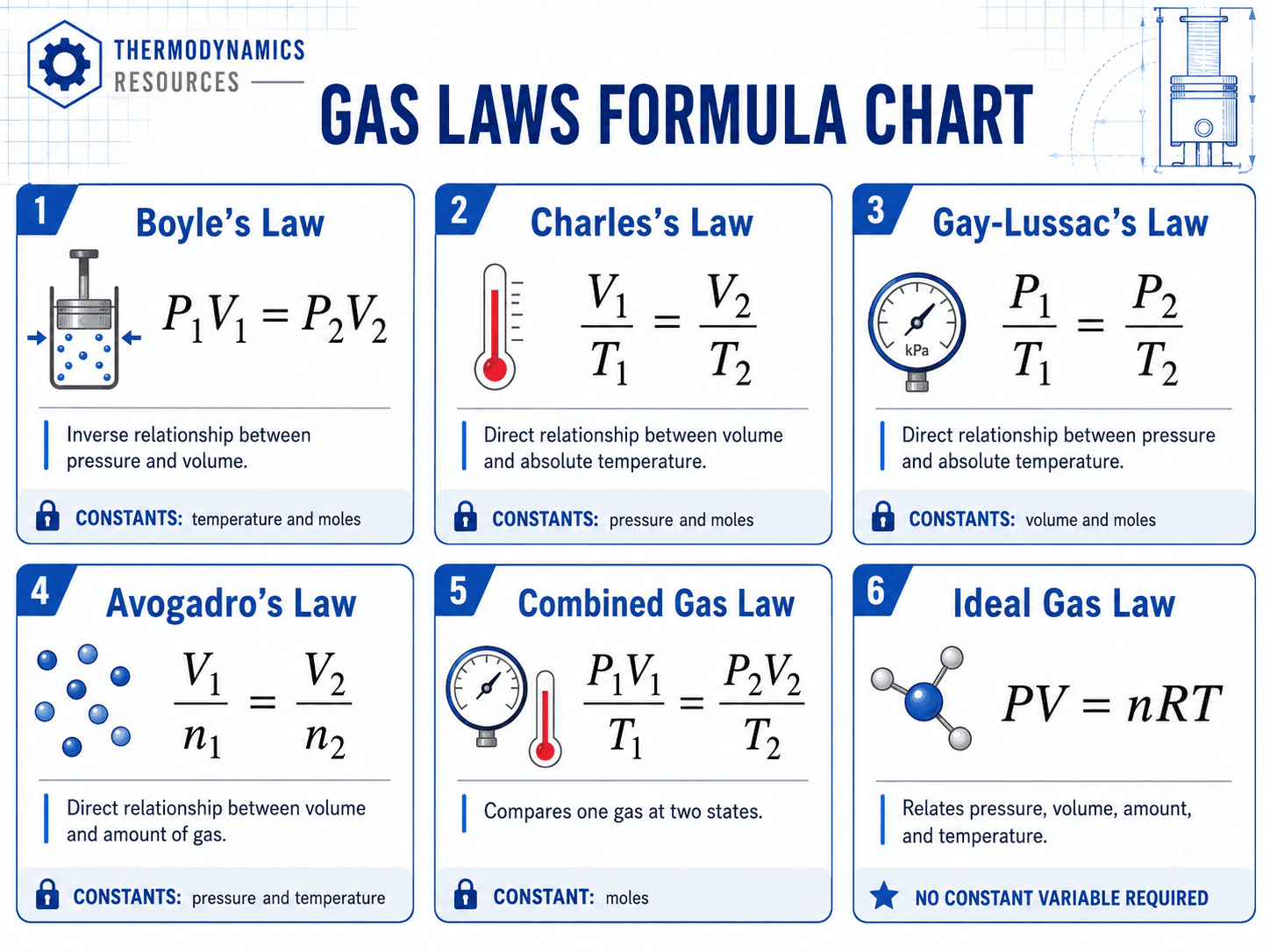
Start by identifying the fixed property. If temperature is constant, pressure and volume are linked by Boyle’s Law. If volume is fixed, pressure follows temperature. If pressure is fixed, volume follows absolute temperature.
What Are Gas Laws?
Gas laws are mathematical relationships between four basic gas properties: pressure \(P\), volume \(V\), absolute temperature \(T\), and amount of gas \(n\). Each law isolates part of that relationship by holding one or more properties constant, making it easier to predict how a gas changes from one state to another.
In engineering thermodynamics, gas laws are not just classroom formulas. They are simplified state relationships used to estimate air density, tank pressure, piston-cylinder behavior, compression effects, and the starting point for more detailed thermodynamic analysis. The important question is not only “what is the equation?” but “which assumptions make that equation valid?”
The Ideal Gas Law can be viewed as a combined relationship that captures Boyle’s pressure-volume behavior, Charles’s volume-temperature behavior, Avogadro’s volume-mole behavior, and the pressure-temperature relationship in one equation of state.
How Pressure, Volume, Temperature, and Moles Work Together
A gas state is controlled by molecular motion, available space, and the number of particles present. Pressure increases when molecules collide with container walls more forcefully or more often. Volume changes the space those molecules occupy. Temperature represents molecular energy on an absolute scale. Moles describe how much gas is present.
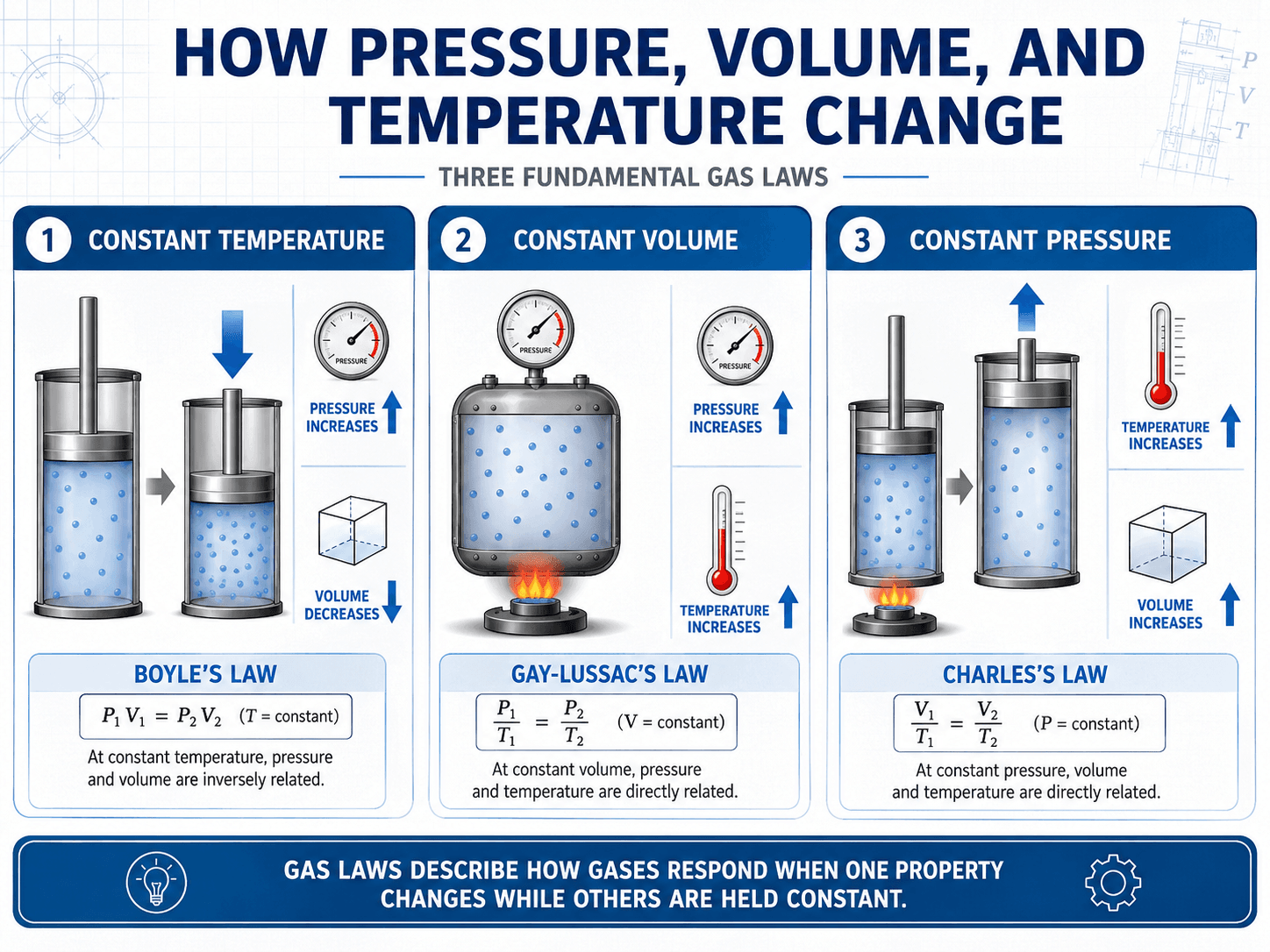
Constant Temperature: Boyle’s Law
When temperature and amount of gas are fixed, pressure and volume move in opposite directions. Compressing the gas into a smaller volume increases the frequency of molecular collisions with the boundary, so pressure rises.
Constant Volume: Gay-Lussac’s Law
When a gas is trapped in a rigid tank, the volume cannot expand. If temperature increases, molecular energy increases, and pressure rises. This is why sealed gas containers, pressure vessels, and compressed-air systems must be evaluated for temperature changes.
Some references call the pressure-temperature relationship Amontons’s Law, while many introductory gas-law charts label it Gay-Lussac’s Law. In engineering thermodynamics, the important point is the constant-volume relationship between absolute pressure and absolute temperature.
Constant Pressure: Charles’s Law
When pressure is held constant, increasing absolute temperature increases volume. A movable piston is the classic example: heating the gas raises molecular energy, and the gas expands until the pressure balances the external load.
Gas Law Equations and When to Use Each One
The best gas-law equation depends on whether the problem compares two states or solves one complete state. Two-state equations are useful when the same gas sample changes from condition 1 to condition 2. The ideal gas law is useful when pressure, volume, temperature, and amount of gas all describe one state.
| Gas law | Equation | Held constant | Typical engineering use |
|---|---|---|---|
| Boyle’s Law | \(P_1V_1=P_2V_2\) | Temperature and moles | Isothermal compression or expansion of a fixed gas quantity |
| Charles’s Law | \(\frac{V_1}{T_1}=\frac{V_2}{T_2}\) | Pressure and moles | Gas expansion under a movable boundary at nearly constant pressure |
| Gay-Lussac’s Law | \(\frac{P_1}{T_1}=\frac{P_2}{T_2}\) | Volume and moles | Pressure rise in sealed tanks or rigid vessels |
| Avogadro’s Law | \(\frac{V_1}{n_1}=\frac{V_2}{n_2}\) | Pressure and temperature | Gas quantity changes where pressure and temperature remain controlled |
| Combined Gas Law | \(\frac{P_1V_1}{T_1}=\frac{P_2V_2}{T_2}\) | Moles | Before-and-after state changes for a fixed amount of gas |
| Ideal Gas Law | \(PV=nR_uT\) | None by default | Single-state calculations involving gas amount, density, pressure, volume, or temperature |
Ideal Gas Law: Molar Form
The molar form of the Ideal Gas Law uses the number of moles and the universal gas constant:
Engineering Forms of the Ideal Gas Law
Engineering thermodynamics often uses mass, density, or specific volume instead of moles. These forms are especially useful for air systems, compressors, closed tanks, ducts, and control-volume calculations.
In molar form, \(R_u\) is the universal gas constant. In mass-based engineering form, \(R\) is the specific gas constant for the gas being analyzed, where \(R = R_u/M\). The two forms are equivalent only when the units and gas basis are consistent.
Ideal Gas Law vs Combined Gas Law
Use the Combined Gas Law when the same amount of gas moves from one state to another and pressure, volume, and temperature may all change. Use the Ideal Gas Law when you need to solve for pressure, volume, temperature, moles, mass, density, or specific volume at one state.
- \(P\) Absolute pressure, commonly in Pa, kPa, bar, atm, psi, or psia. Use absolute pressure, not gauge pressure.
- \(V\) Total volume occupied by the gas, commonly in m³, L, ft³, or in³.
- \(v\) Specific volume, commonly in m³/kg or ft³/lbm.
- \(\rho\) Density, commonly in kg/m³ or lbm/ft³.
- \(n\) Amount of gas in moles, lbmol, or kmol depending on the unit system.
- \(m\) Mass of gas, commonly in kg or lbm.
- \(R_u\) Universal gas constant used with moles.
- \(R\) Specific gas constant used with mass, density, or specific volume.
- \(T\) Absolute temperature, typically K or °R. Do not use °C or °F directly in gas-law ratios.
Gas Laws in Thermodynamic Processes
Gas laws are closely tied to thermodynamic processes because each process describes how a gas moves from one state to another. The gas-law relationship changes depending on the boundary condition, heat transfer behavior, and whether pressure, volume, or temperature is controlled.
| Process type | What stays constant or controlled | Gas-law connection | Engineering example |
|---|---|---|---|
| Isothermal | Temperature remains constant | For an ideal gas, pressure and volume follow Boyle’s Law. | Slow compression with enough heat transfer to maintain temperature |
| Isobaric | Pressure remains constant | Volume changes directly with absolute temperature. | Gas expanding under a movable piston with constant external load |
| Isochoric | Volume remains constant | Pressure changes directly with absolute temperature. | Heating a sealed rigid tank |
| Adiabatic | No heat transfer crosses the boundary | Temperature usually changes, so simple Boyle’s Law is not enough. | Rapid compression or expansion where heat transfer time is limited |
| Polytropic | The process follows \(PV^x=C\) | Often used as a practical model between ideal isothermal and adiabatic behavior. | Compressor and expander modeling |
A key engineering judgment is whether a real process behaves closer to an isothermal process, an adiabatic process, or a more realistic polytropic process.
How Engineers Use Gas Laws
Engineers use gas laws as the first layer of gas behavior modeling. They are especially useful when the gas behaves close to ideal and when a quick pressure, volume, temperature, density, or mass estimate is needed before moving into a full energy balance, property table lookup, or real-gas model.
The Ideal Gas Law is especially useful because it turns a gas state into a practical engineering estimate. The same equation can support early checks for stored air, piston-cylinder devices, ducted air, compressor discharge, and pressure vessel behavior.
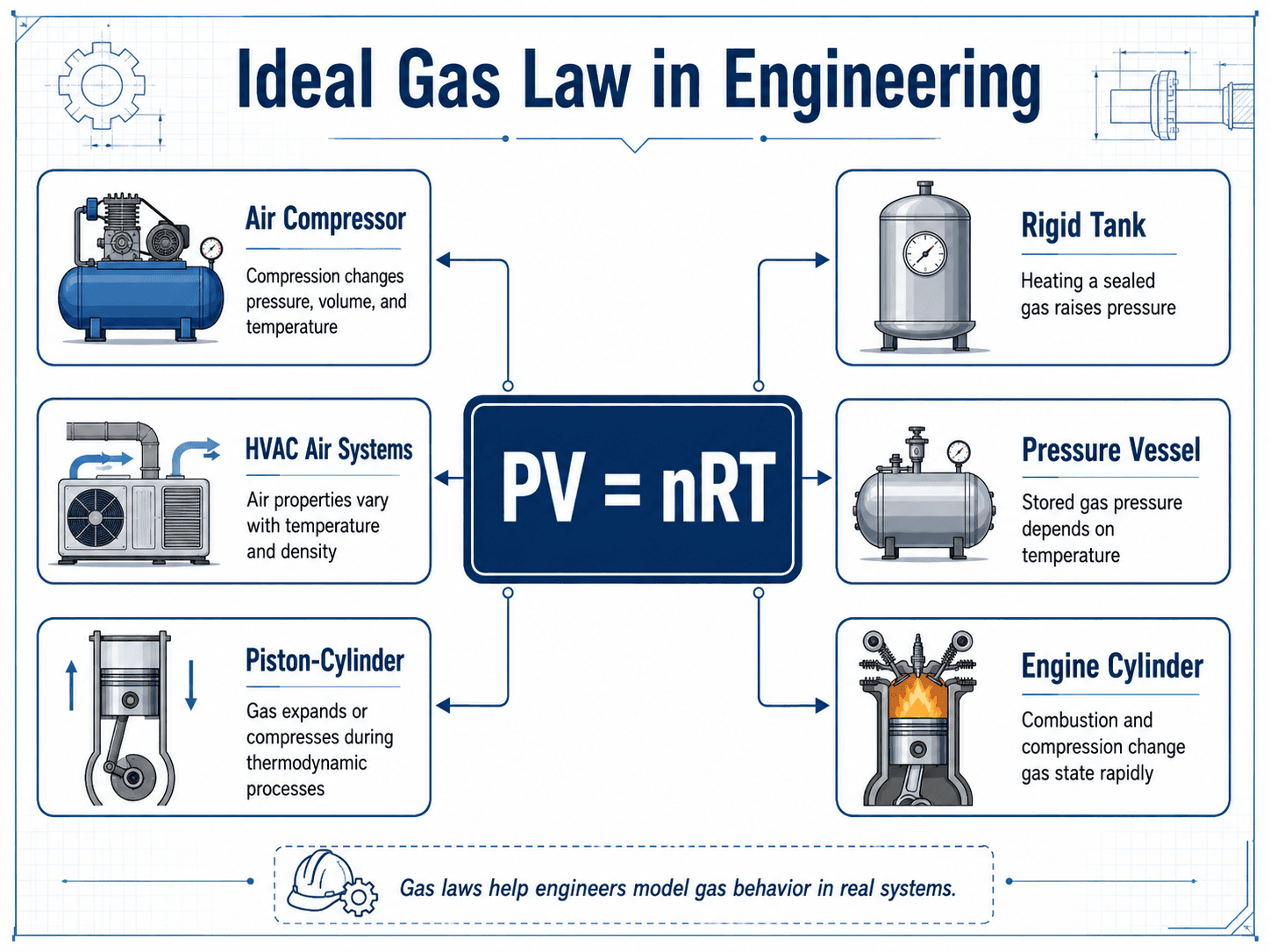
- Air compressors: Estimate how pressure and temperature change during compression before detailed compressor efficiency is considered.
- Rigid tanks: Check how stored gas pressure changes when ambient or process temperature changes.
- Piston-cylinder systems: Relate pressure, volume, and temperature during expansion or compression processes.
- HVAC air systems: Estimate density changes that affect airflow, mass flow, fan performance, and thermal calculations.
- Pressure vessels: Review pressure changes caused by gas temperature changes in fixed-volume systems.
- Engines and cycles: Approximate gas states during compression, combustion, expansion, and exhaust portions of a cycle.
In HVAC work, air often contains water vapor, so moist-air properties may require psychrometric relationships rather than a dry-air ideal gas estimate alone.
A gas-law result should be treated as a state estimate, not a complete thermodynamic analysis. If heat transfer, shaft work, boundary work, mass flow, or efficiency matters, connect the gas state to an energy-balance method such as the First Law of Thermodynamics.
Key Factors That Control Gas Law Accuracy
Gas law accuracy depends on units, absolute properties, gas composition, pressure range, temperature range, and whether the process really holds the assumed variable constant. Many errors are not algebra errors; they come from applying the right-looking equation to the wrong physical situation.
- The gas is well mixed and has a reasonably uniform temperature.
- The gas behaves approximately ideally over the pressure and temperature range being analyzed.
- The pressure value is absolute pressure.
- The temperature value is absolute temperature.
- The constant-property assumption matches the physical process.
- The correct gas constant is used for the gas and unit basis.
| Factor | Why it matters | Engineering implication |
|---|---|---|
| Absolute pressure | Gas laws are based on pressure relative to vacuum, not gauge pressure. | Convert psig to psia, or gauge pressure to absolute pressure, before using gas-law equations. |
| Absolute temperature | Temperature ratios require a true zero point tied to molecular energy. | Use Kelvin or Rankine; do not insert Celsius or Fahrenheit directly into \(P/T\), \(V/T\), or \(PV/T\) ratios. |
| Constant-property assumption | Each simple gas law assumes one or more variables are fixed. | Use the combined gas law or ideal gas law when multiple properties change together. |
| Real-gas behavior | Ideal gas behavior becomes less accurate when molecular forces and molecular volume matter. | At high pressure, low temperature, or near condensation, use compressibility corrections or real-gas property data. |
| Gas composition | Air, steam, refrigerants, combustion gas, and process gas can behave differently. | Use the correct gas constant, molecular weight, and property model for the fluid being analyzed. |
Which Gas Law Should You Use?
The fastest way to choose a gas law is to identify the known state variables, the unknown variable, and what remains constant. The table below works as a practical decision guide for homework, thermodynamics review, and early engineering estimates.
First, decide whether the problem is a one-state or two-state problem. Then identify the fixed property. If moles are fixed and pressure, volume, and temperature all change, use the combined gas law. If the amount of gas, mass, density, or specific volume is needed, use the ideal gas law.
| Check or decision | What to look for | Best equation path |
|---|---|---|
| Only pressure and volume change | Temperature and amount of gas stay constant. | Use Boyle’s Law: \(P_1V_1=P_2V_2\). |
| Only volume and temperature change | Pressure and amount of gas stay constant. | Use Charles’s Law: \(\frac{V_1}{T_1}=\frac{V_2}{T_2}\). |
| Only pressure and temperature change | Volume and amount of gas stay constant. | Use Gay-Lussac’s Law: \(\frac{P_1}{T_1}=\frac{P_2}{T_2}\). |
| Pressure, volume, and temperature all change | The same gas mass is compared between two states. | Use the Combined Gas Law: \(\frac{P_1V_1}{T_1}=\frac{P_2V_2}{T_2}\). |
| Gas quantity, density, or one full state is needed | Pressure, volume, temperature, and moles or mass are part of the same state. | Use the Ideal Gas Law: \(PV=nR_uT\), \(PV=mRT\), \(Pv=RT\), or \(P=\rho RT\). |
Gas Law Units and Sanity Checks
Gas-law calculations are very sensitive to unit consistency. A formula can be algebraically correct and still produce the wrong answer if pressure, temperature, volume, or the gas constant are on mismatched bases.
| Calculation basis | Use this pressure | Use this temperature | Gas constant basis |
|---|---|---|---|
| SI molar | Pa or kPa on an absolute basis | K | Universal gas constant \(R_u\) in matching molar units |
| SI mass | Pa or kPa on an absolute basis | K | Specific gas constant \(R\), such as J/kg·K or kJ/kg·K |
| US customary | psia, not psig | °R | Specific gas constant in consistent ft·lbf/lbm·°R units |
| Gauge readings | Convert gauge pressure to absolute pressure | Convert to K or °R | Do not mix gauge pressure with absolute gas-law relationships |
If a gauge reads 100 psig at standard atmospheric conditions, the gas-law pressure is approximately 114.7 psia, not 100 psi. Gas-law pressure must be absolute.
Gas Laws Example: Heating a Rigid Air Tank
A sealed air tank starts at 300 kPa absolute and 20°C. The tank is heated to 60°C. Because the tank is rigid and sealed, volume and gas mass are constant, so the pressure-temperature relationship applies.
Assume the air behaves as an ideal gas, the tank volume is fixed, the gas mass does not change, the pressure values are absolute, and the air temperature is uniform throughout the tank.
Step 1: Convert Temperature to Kelvin
\(T_1 = 20 + 273.15 = 293.15 \, K\) and \(T_2 = 60 + 273.15 = 333.15 \, K\). This conversion is not optional because gas-law temperature ratios must use absolute temperature.
Step 2: Apply the Constant-Volume Pressure-Temperature Relationship
Interpretation
The pressure increases by about 13.6% because the gas is heated in a fixed volume. In a real pressure vessel or compressed-air receiver, this is why temperature exposure matters even when no additional gas is added to the tank.
Engineering Judgment and Field Reality
Real systems rarely follow a single textbook gas law perfectly. A compressor may heat the gas while reducing volume. A tank may not be perfectly rigid. A piston-cylinder device may lose heat to its surroundings. HVAC air may include water vapor. Combustion gas changes composition while it expands.
Experienced engineers use gas laws as a first check, then decide whether the problem needs a more complete model. Slow compression may approach isothermal behavior, while rapid compression can produce a large temperature rise that simple Boyle’s Law alone will not capture.
In open systems, engineers often move beyond \(PV=nR_uT\) or \(PV=mRT\) and use properties such as enthalpy to account for flow energy, heat transfer, shaft work, and mass flow through equipment.
The most important practical question is often whether the process is slow enough to exchange heat with the surroundings. Slow compression may approach isothermal behavior, while rapid compression can produce a large temperature rise that requires an adiabatic or polytropic model.
When This Breaks Down
Basic gas laws work best when the gas behaves approximately ideally and the stated constant-property assumptions are reasonable. They become less reliable when the gas is dense, near phase change, reacting chemically, flowing through equipment with losses, or exchanging significant heat and work in ways the simplified equation does not include.
The compressibility factor \(Z\) is one way to represent real-gas deviation. When \(Z = 1\), the gas behaves ideally. When \(Z\) differs from 1, molecular volume and intermolecular forces are affecting the pressure-volume-temperature relationship.
- High pressure: Molecular volume becomes more important, so ideal-gas predictions can understate or overstate actual behavior.
- Low temperature or near condensation: Intermolecular forces become more significant, especially for refrigerants, steam, and process gases.
- Changing gas composition: Combustion, chemical reactions, humidity, or gas mixing can change molecular weight and gas properties.
- Fast compression or expansion: Temperature may change rapidly, so a constant-temperature assumption can be misleading.
- Flowing systems: Compressors, nozzles, turbines, and ducts may require control-volume analysis, not only a closed-gas relationship.
For flowing equipment, start by distinguishing whether the system is better treated as a closed system or an open system.
Common Mistakes and Practical Checks
Most gas-law mistakes come from unit handling, pressure basis, temperature basis, or choosing a law based on the variables shown instead of the physical boundary condition. The equation must match the actual system behavior.
- Using gauge pressure: Convert gauge pressure to absolute pressure before using gas laws.
- Using Celsius or Fahrenheit directly: Convert to Kelvin or Rankine before using temperature ratios.
- Ignoring what is constant: Boyle’s Law only applies if temperature and amount of gas remain constant.
- Mixing unit systems: Match \(R_u\) or \(R\), pressure, volume, temperature, and amount of gas within one consistent unit system.
- Confusing molar and mass-based forms: \(PV=nR_uT\) and \(PV=mRT\) are not interchangeable unless the gas constant and amount basis are changed correctly.
- Treating ideal gas behavior as universal: Check pressure, temperature, and fluid type before trusting a simple ideal-gas result.
The biggest gas-law error is using the right equation with the wrong temperature or pressure scale. If temperature is not absolute or pressure is not absolute, the result can look mathematically clean but be physically wrong.
Useful References and Engineering Data
Gas-law calculations depend on reliable constants and consistent units. For engineering work, the gas constant should be selected from a trusted source and matched carefully to the unit system used in the calculation.
- NIST reference value: NIST CODATA molar gas constant provides an authoritative reference value for the molar gas constant used in ideal gas law calculations.
- Project-specific criteria: Real projects may also require owner specifications, equipment manufacturer data, pressure vessel requirements, HVAC design criteria, or process-specific gas property data.
- Engineering use: Engineers use reference constants and fluid properties to keep calculations traceable before moving into detailed models, property tables, software, or test data.
Frequently Asked Questions
The main gas laws are Boyle’s Law, Charles’s Law, Gay-Lussac’s Law, Avogadro’s Law, the Combined Gas Law, and the Ideal Gas Law. Together, they describe how pressure, volume, temperature, and amount of gas are related under different constant-property assumptions.
Choose the gas law based on what changes and what stays constant. Use Boyle’s Law for pressure-volume changes at constant temperature, Charles’s Law for volume-temperature changes at constant pressure, Gay-Lussac’s Law for pressure-temperature changes at constant volume, the Combined Gas Law for two-state problems with fixed moles, and the Ideal Gas Law when pressure, volume, temperature, moles, mass, density, or specific volume are part of one state calculation.
Gas law temperature must be absolute because the equations are based on molecular energy, not relative temperature scales. Celsius and Fahrenheit have arbitrary zero points, so using them directly can create incorrect ratios and impossible pressure or volume predictions.
The ideal gas law becomes less reliable at high pressure, low temperature, near condensation, or when molecular size and intermolecular forces are no longer negligible. Engineers may then use compressibility factor corrections, property tables, or a real-gas equation of state.
Summary and Next Steps
Gas laws explain how pressure, volume, temperature, and amount of gas are related. They provide the foundation for estimating gas states in tanks, pistons, compressors, HVAC air systems, pressure vessels, and thermodynamic cycles.
The most important practical steps are to use absolute pressure, use absolute temperature, choose the law that matches the actual constant-property assumption, and recognize when ideal-gas behavior is only a first estimate.
Where to go next
Continue your learning path with related Turn2Engineering resources.
-
Isothermal Process
Learn how constant-temperature gas behavior connects directly to pressure-volume changes and Boyle’s Law.
-
Adiabatic Process
Review gas compression and expansion when heat transfer is negligible and temperature changes matter.
-
Thermodynamic Cycles
See how gas states, pressure-volume behavior, heat transfer, and work combine in repeating energy systems.