
Key Takeaways
- Core idea: Civil engineering companies plan, design, permit, and support infrastructure and land-development projects.
- Engineering use: They turn project needs into drawings, calculations, agency submittals, construction documents, and field support.
- What controls it: The right firm depends on project type, local permitting requirements, technical specialty, schedule, and risk.
- Practical check: Start with project fit: similar work, local agency experience, licensed PE involvement, construction support, and clear scope usually matter more than company size.
Table of Contents
Introduction
Civil engineering companies, also called civil engineering firms or civil engineering consulting companies, plan, design, permit, and support construction of infrastructure and land-development projects. They work on roads, bridges, grading plans, drainage systems, utilities, subdivisions, site plans, and public works, helping turn a project concept into buildable drawings and agency-approved documents.
Types of Civil Engineering Companies
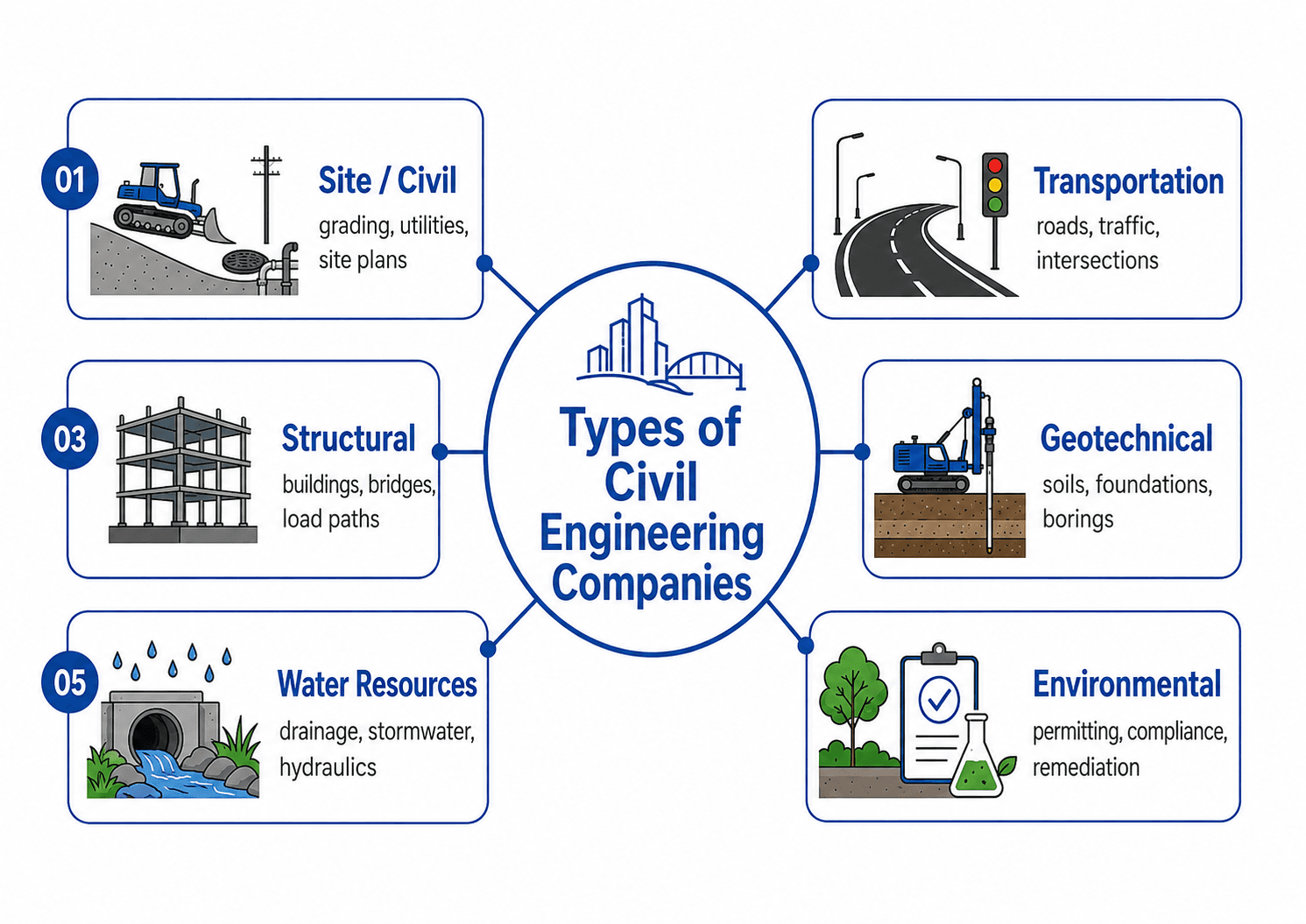
Start by matching the project problem to the right civil engineering specialty. A drainage problem, traffic study, foundation concern, and bridge repair may all involve civil engineering, but they do not require the same type of company.
What Do Civil Engineering Companies Do?
Civil engineering companies provide professional engineering services for the built environment. Their work often begins before construction, when a property owner, developer, agency, architect, or contractor needs to understand whether a project is feasible, what permits are required, and what engineering constraints control the design.
A civil engineering firm may prepare site plans, grading plans, stormwater reports, utility layouts, roadway designs, construction details, quantity estimates, specifications, and agency submittal packages. On many projects, the firm also responds to plan review comments, coordinates with surveyors and geotechnical engineers, and supports the contractor during construction.
The practical value is not just producing drawings. Good civil engineering companies identify conflicts early: inadequate drainage, poor access, utility clashes, unrealistic grading, floodplain issues, poor soils, insufficient fire access, or agency requirements that could delay approval if missed.
Common Civil Engineering Company Services
Services vary by company, but most civil engineering firms are organized around project delivery. They help define the problem, collect data, design the solution, prepare permit documents, and answer technical questions during construction.
| Service area | Typical deliverables | Why it matters |
|---|---|---|
| Site and land development | Site plans, grading plans, utility layouts, parking layouts, fire access plans, and construction details | Connects the building, roads, drainage, utilities, and agency requirements into one buildable site plan. |
| Drainage and stormwater | Drainage reports, runoff calculations, detention design, storm sewer layouts, culverts, and erosion-control plans | Controls flooding risk, downstream impacts, permitting comments, and long-term site performance. |
| Transportation and traffic | Traffic studies, roadway layouts, intersection analysis, access management, signal concepts, and corridor improvements | Determines whether a development or public project can move vehicles, pedestrians, cyclists, and freight safely. |
| Utilities and public infrastructure | Water, sewer, storm drain, dry utility coordination, easement coordination, and connection layouts | Utility conflicts are one of the most common causes of redesign, construction delays, and field changes. |
| Structural coordination | Bridge, retaining wall, building, or support-structure coordination with structural engineering specialists | Ensures loads, foundations, drainage, access, and constructability are coordinated across disciplines. |
| Geotechnical coordination | Soil boring coordination, geotechnical report review, foundation recommendations, pavement subgrade input, and earthwork criteria | Reduces surprises from weak soils, groundwater, settlement, slope instability, or unsuitable fill. |
| Permitting and agency support | Plan submittals, technical reports, agency comment responses, revisions, and approval coordination | Permitting is often where schedule risk appears; local review experience can be as important as design ability. |
| Construction support | RFIs, shop drawing review, field observations, change coordination, record drawings, and closeout support | Helps resolve field questions before they become costly rework, delays, or performance problems. |
A proposal that only lists “civil engineering services” is not specific enough. A useful scope should identify the drawings, reports, meetings, permit submittals, agency responses, and construction-phase tasks included.
Who Hires Civil Engineering Companies?
Civil engineering companies are hired by many different clients because civil work sits between land, infrastructure, permitting, and construction. The same firm may support a developer on a commercial site one month and a municipality on a road, drainage, or utility improvement the next.
| Client type | Why they hire a civil engineering company | Common project examples |
|---|---|---|
| Developers | To prepare site plans, grading, drainage, utilities, permitting documents, and construction plans | Retail centers, apartments, subdivisions, industrial parks, and mixed-use developments |
| Property owners | To solve site access, drainage, redevelopment, utility, parking, or expansion issues | Drainage corrections, parking lot expansions, driveway improvements, and site redevelopment |
| Architects | To coordinate building design with grading, access, stormwater, utilities, and site constraints | Schools, offices, medical buildings, municipal buildings, and commercial buildings |
| Municipalities and public agencies | To design, study, inspect, or manage public infrastructure | Roads, sidewalks, drainage systems, water lines, sewer lines, parks, and public works projects |
| Contractors | To support design-build work, RFIs, constructability questions, field changes, or temporary engineering needs | Utility conflicts, grading changes, drainage adjustments, and construction-phase redesign |
| Industrial and campus owners | To plan long-term infrastructure, stormwater, access roads, utility capacity, and site expansions | Manufacturing sites, warehouses, solar facilities, universities, hospitals, and corporate campuses |
Civil Engineering Company Project Workflow
Most civil engineering companies follow a staged workflow. The exact order can change by project, but the same core pattern appears repeatedly: evaluate feasibility, collect data, develop design concepts, submit for approval, issue construction documents, support construction, and close out the record.
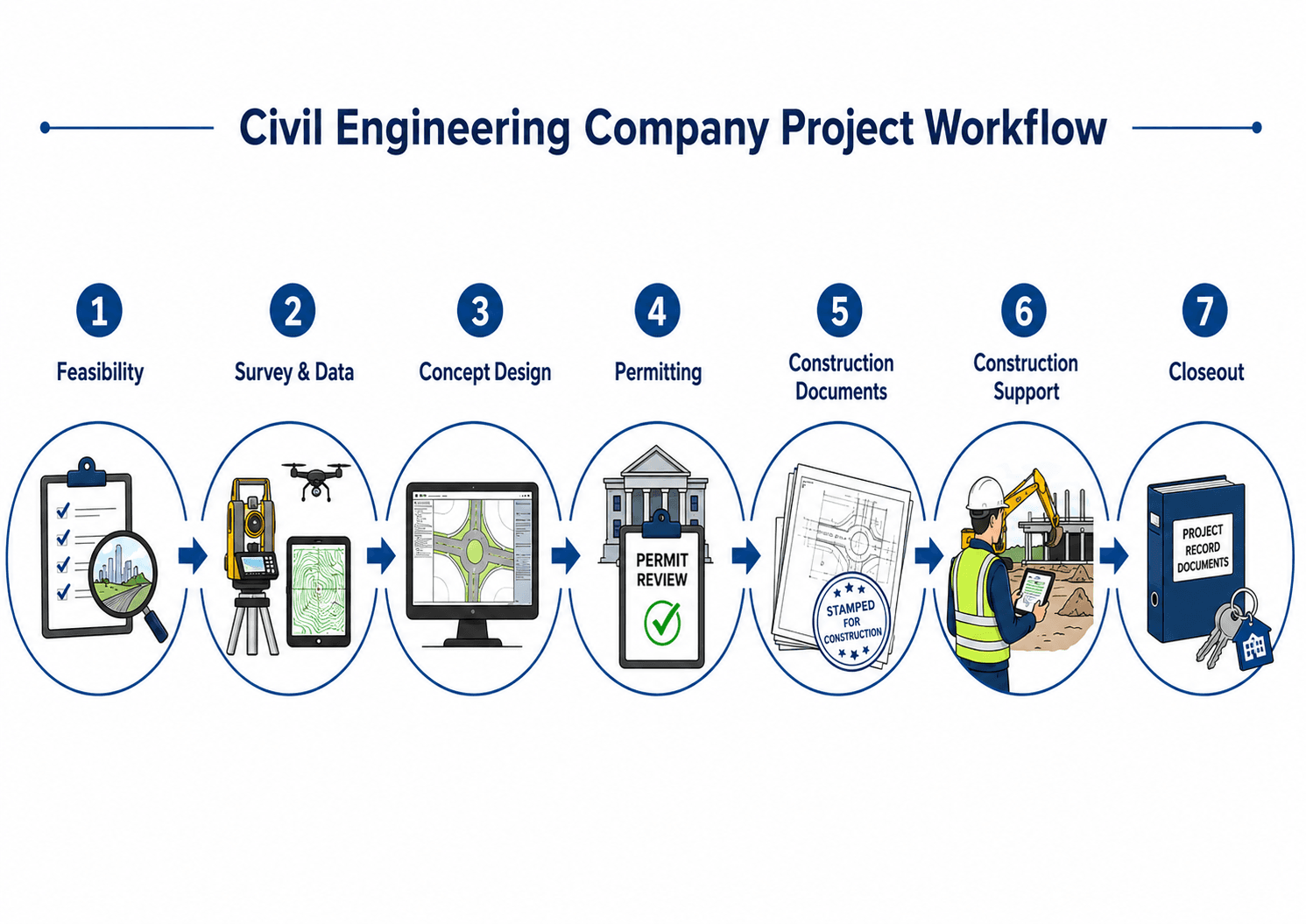
Feasibility and data collection
Early feasibility work is where strong firms prevent expensive wrong turns. The engineer reviews the site, owner goals, survey needs, utility records, stormwater constraints, access points, zoning conditions, floodplain information, and agency requirements before the design is too far along to change efficiently.
Design and permitting
During design, the company converts the concept into technical drawings and reports. This may include grading, drainage, utility design, roadway geometry, erosion control, construction details, and calculations. During permitting, the company responds to agency comments and revises the plans until the project meets review requirements.
Construction support and closeout
Construction support is where design intent meets field conditions. Civil engineering companies may answer RFIs, review substitutions, address unforeseen utility conflicts, clarify details, observe construction, and help prepare record documents that show what was actually built.
Civil Engineering Firm Types and Specialties
The phrase “civil engineering company” covers many business models. Some firms are small local site/civil offices. Others are large multidisciplinary companies with transportation, structural, geotechnical, environmental, water resources, survey, planning, and construction-management teams under one roof.
| Firm type | Best fit | Common mistake to avoid |
|---|---|---|
| Site / civil firm | Commercial sites, subdivisions, grading, utilities, parking, drainage, and local permits | Assuming a general civil firm automatically has deep traffic, geotechnical, or structural expertise in-house. |
| Transportation engineering firm | Roadways, intersections, traffic studies, signal concepts, access management, and corridor planning | Using a site plan designer for a project that needs detailed traffic operations or roadway design judgment. |
| Structural engineering firm | Buildings, bridges, retaining walls, towers, load paths, member sizing, and stability checks | Confusing structural engineering with site/civil engineering; they solve different parts of the project. |
| Geotechnical engineering firm | Soil borings, foundations, settlement, slope stability, earthwork, pavements, and groundwater conditions | Treating the geotechnical report as a formality instead of a key input to civil and structural decisions. |
| Water resources firm | Stormwater, flood studies, channels, detention, hydrology, hydraulics, and drainage infrastructure | Underestimating drainage complexity because the visible site looks simple during dry weather. |
| Environmental engineering firm | Permitting, compliance, remediation, water quality, environmental reports, and regulatory coordination | Waiting until late design to identify environmental constraints that affect grading, utilities, or construction access. |
| Multidisciplinary company | Large public infrastructure, complex programs, multi-site portfolios, and projects with several technical disciplines | Paying for a large-company structure when a focused local firm would deliver the project more efficiently. |
For background on the broader discipline, start with what civil engineering covers. For closely related specialties, see structural engineering, geotechnical engineering, and transportation engineering.
Civil Engineering Company vs Contractor, Architect, Surveyor, and Structural Engineer
Civil engineering companies often work beside other project professionals, which can make their role look blurry from the outside. The simplest distinction is that civil engineers solve infrastructure and site-related engineering problems, while other project roles solve different parts of the delivery process.
| Project role | Main responsibility | How it connects to civil engineering |
|---|---|---|
| Civil engineering company | Plans, designs, permits, and supports infrastructure, site, drainage, utility, and roadway work | Creates the engineering documents and technical basis for site and infrastructure construction. |
| Construction company | Builds the project using labor, equipment, materials, subcontractors, and construction sequencing | Uses civil drawings and specifications to construct the work and asks RFIs when field conditions differ. |
| Architect | Leads building layout, space planning, user needs, envelope, aesthetics, and code coordination for buildings | Coordinates with civil engineers for site layout, access, grading, utilities, and stormwater design. |
| Surveyor | Measures property boundaries, topography, easements, control points, and existing site conditions | Provides base data that civil engineers use for grading, drainage, utility, and site design. |
| Structural engineer | Designs load-resisting systems such as beams, columns, slabs, walls, foundations, and bridges | Coordinates with civil engineers where foundations, walls, bridges, drainage, and site conditions interact. |
Many project problems happen at the interfaces between disciplines: a utility line crossing a footing, a retaining wall changing drainage patterns, a driveway grade that does not match the road, or a storm structure located where construction access is needed.
Examples of Major Civil Engineering Companies
Some searchers looking for civil engineering companies want examples of large firms. The companies below are examples of well-known engineering and design firms that commonly appear in civil infrastructure, land development, transportation, water, environmental, public works, and multidisciplinary engineering markets. They are not automatically the best fit for every project.
| Company example | Common civil / infrastructure relevance | Best-use context |
|---|---|---|
| AECOM | Large multidisciplinary infrastructure, transportation, water, environmental, and program work | Major public infrastructure, complex programs, and multi-discipline project delivery |
| Jacobs | Infrastructure, water, transportation, buildings, environmental, and program-management services | Large public and private infrastructure programs requiring broad engineering capacity |
| Tetra Tech | Water, environmental, infrastructure, federal, and technical consulting work | Water resources, environmental permitting, public infrastructure, and technical advisory work |
| WSP USA | Transportation, buildings, infrastructure, energy, water, and environmental services | Transportation corridors, public infrastructure, and multidisciplinary design support |
| HDR | Transportation, water, architecture/engineering, public infrastructure, and planning | Municipal, state, water, bridge, roadway, and public-sector infrastructure projects |
| Kimley-Horn | Land development, transportation, planning, site/civil, roadway, and private development work | Private development, site plans, transportation planning, and local civil consulting |
| Stantec | Community development, water, transportation, environmental, buildings, and infrastructure services | Public and private projects needing civil, environmental, planning, and infrastructure coordination |
| Arcadis | Water, environment, infrastructure, resilience, and consulting services | Water, environmental, resilience, remediation, and urban infrastructure projects |
Use company examples for market context, not as a shortcut for selection. A smaller local civil engineering firm may be the stronger choice for a site plan, drainage correction, local subdivision, or permit-heavy project if it has the right local experience.
How to Evaluate Civil Engineering Companies Near You
For many real projects, local experience can matter more than national recognition. A civil engineering company near the project site may already understand the reviewing agency, stormwater criteria, utility providers, zoning expectations, fire access requirements, and common permitting issues in that jurisdiction.
| Local evaluation check | What to look for | Why it matters |
|---|---|---|
| Recent local approvals | Examples of projects approved by the same city, county, DOT, utility provider, or review agency | Shows the firm understands the local review process and likely plan-comment patterns. |
| Stormwater and drainage criteria | Familiarity with local detention, water quality, floodplain, erosion-control, and downstream-impact requirements | Drainage is one of the most common causes of redesign and permit delays. |
| Utility coordination | Experience coordinating water, sewer, storm drain, dry utilities, easements, and connection approvals | Utility conflicts can affect grading, access, construction sequencing, and cost. |
| Review meetings and site walks | Ability to attend local meetings, pre-application conferences, and field reviews when needed | Direct communication can resolve issues faster than repeated drawing comments. |
| Local field conditions | Awareness of regional soils, rainfall patterns, flood risk, pavement conditions, and construction access constraints | Local physical conditions often control practical engineering decisions more than generic design assumptions. |
Ask for examples of approved projects in the same jurisdiction. A firm that has already worked with the local reviewers may be able to anticipate comments before the first submittal.
How to Choose the Right Civil Engineering Company
Choosing a civil engineering company is not just a branding decision. A better question is: has this firm solved this type of problem, in this type of jurisdiction, with this level of technical risk, on a similar schedule?
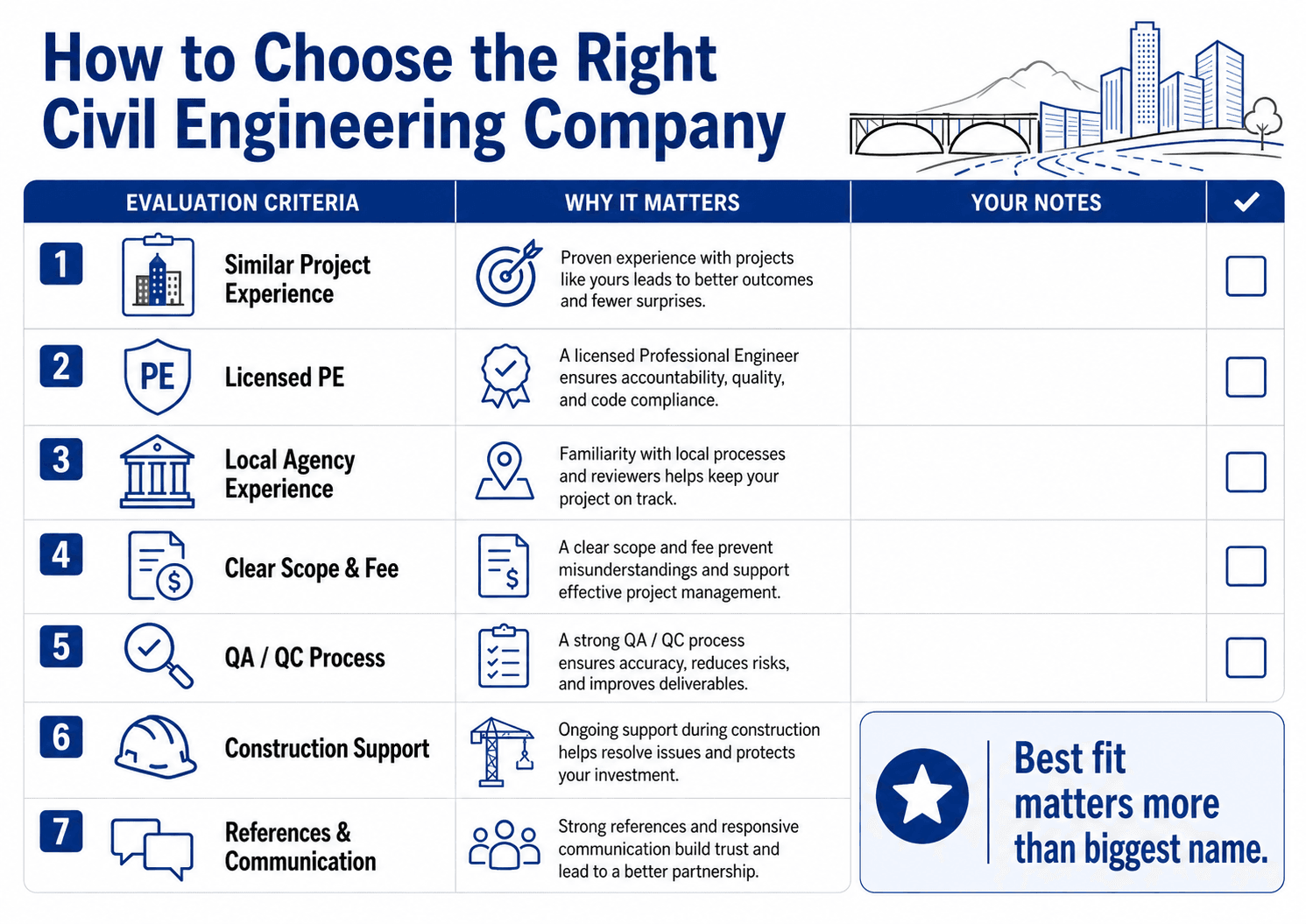
A strong selection process reviews both qualifications and project delivery behavior. Similar project experience matters, but so do responsiveness, constructability judgment, local review experience, and the ability to explain risks before they become change orders.
Questions to Ask Before Hiring a Civil Engineering Company
The best hiring conversations are specific. Instead of asking only for a fee, ask how the firm will handle the project’s technical scope, agency process, communication path, and construction-phase questions.
- Have you completed similar projects in this jurisdiction?
- Who will be the project manager, lead designer, reviewer, and engineer of record?
- What drawings, calculations, reports, and permit submittals are included?
- Are agency comments, revisions, and resubmittals included in the scope?
- What is excluded from the proposal?
- Do you provide construction-phase support for RFIs, field conflicts, and record drawings?
- What survey, title, utility, geotechnical, environmental, or owner information do you need before starting?
- Which subconsultants are required, and who coordinates them?
- How do you handle utility conflicts, drainage issues, access constraints, and design changes?
- How often will the team communicate progress, risks, and review comments?
A good civil engineering company should be able to explain the likely approval path, major risks, missing information, and scope assumptions before design begins.
Civil Engineering Company Selection Table
Use this decision table to match a project need to the most likely company type. It is not a replacement for a request for qualifications, but it helps prevent the most common hiring mistake: selecting a firm by name recognition instead of technical fit.
Define the project problem first, identify the controlling discipline second, then evaluate firms based on similar work, local agency experience, licensed engineer involvement, construction support, and scope clarity.
| Project need | Best-fit company type | Question to ask before hiring |
|---|---|---|
| Commercial site plan | Site / civil or land-development firm | Have you recently permitted similar projects in this city, county, or review agency? |
| Subdivision or residential development | Land-development civil firm | Do you handle plats, grading, utilities, drainage, and agency comment responses as one coordinated scope? |
| Drainage problem or stormwater review | Water resources or stormwater-focused civil firm | Can you evaluate runoff, detention, conveyance, downstream impacts, and maintenance needs? |
| Roadway, driveway, or intersection issue | Transportation or traffic engineering firm | Can you evaluate traffic volumes, sight distance, access, turning movements, and safety impacts? |
| Foundation, settlement, or slope risk | Geotechnical engineering firm | Will the scope include borings, testing, groundwater observations, and recommendations tied to the proposed structure? |
| Bridge, building frame, retaining wall, or load-bearing structure | Structural engineering firm | Will a qualified structural engineer review the load path, stability, foundations, and constructability? |
| Large public infrastructure program | Multidisciplinary engineering company | Can the firm manage civil, structural, geotechnical, environmental, transportation, and construction-phase coordination? |
Civil Engineering Scope of Work Red Flags
Many civil engineering problems begin with a weak proposal, not a weak drawing. A clear scope should tell the owner what is included, what is excluded, what assumptions were made, and what happens when review comments or construction questions appear.
| Red flag | Why it matters | Better question to ask |
|---|---|---|
| “Civil engineering services” with no deliverable list | The owner may not know whether drawings, reports, calculations, meetings, or revisions are included. | What specific drawings, reports, and submittals are included? |
| No mention of agency comments | Plan review responses can become extra cost or cause schedule delays if excluded. | How many review cycles and resubmittals are included? |
| No construction support included | RFIs, utility conflicts, and field changes may require engineering input after plans are issued. | Do you support RFIs, field revisions, and record drawings during construction? |
| No survey or geotechnical assumptions | Design may rely on incomplete information about boundaries, grades, utilities, soils, or groundwater. | What information must be provided before design starts? |
| No QA/QC process described | Plan errors, missed coordination items, and inconsistent details can increase rework risk. | Who reviews the plans before submittal? |
| No named project manager | Communication can become unclear if the proposal lead is not managing the work. | Who is my day-to-day contact and who is responsible for final engineering decisions? |
Small Local Firm vs Large National Civil Engineering Company
A small local civil firm and a large national engineering company can both be excellent, but they solve different problems well. The right choice depends on project complexity, schedule, agency relationships, staffing needs, and how many disciplines must be coordinated.
| Choice | Often strong for | Watch for |
|---|---|---|
| Small local civil firm | Site plans, local permitting, small commercial projects, subdivisions, drainage fixes, and responsive owner coordination | Limited specialty depth or staffing capacity if the project grows into traffic, geotechnical, environmental, or structural complexity. |
| Mid-size regional firm | Projects needing several civil specialties, repeat agency coordination, and enough staff for schedule pressure | May still rely on subconsultants for specialty work, so coordination responsibilities should be clear. |
| Large national or global company | Major infrastructure, public-sector programs, multi-discipline delivery, federal/state work, and complex project controls | May be less efficient for small projects if the fee structure, staffing model, or communication path is too heavy. |
Bigger is useful when the project needs depth, staffing, and multiple disciplines. Local is useful when permitting knowledge, responsiveness, and focused site experience are the main risks.
Real Project Examples for Civil Engineering Companies
Civil engineering company selection becomes easier when the project is framed as a specific engineering problem instead of a broad request for “civil plans.” These examples show how different project types create different engineering needs.
| Project example | Engineering issues involved | Best-fit firm characteristics |
|---|---|---|
| Commercial retail site | Grading, stormwater detention, parking layout, ADA slopes, fire access, utility tie-ins, and permit comments | Site/civil firm with local land-development approvals and construction-document experience |
| Residential subdivision | Roads, lots, plat coordination, water, sewer, drainage, erosion control, and agency submittals | Land-development firm experienced with subdivision design and local review agencies |
| City roadway improvement | Roadway geometry, traffic control, sidewalks, drainage, utility relocation, and public bid documents | Transportation or municipal infrastructure firm with public-sector delivery experience |
| Drainage complaint or flooding issue | Survey, watershed area, runoff path, downstream discharge, inlet capacity, culverts, and detention options | Water resources or stormwater-focused civil firm with hydrology and hydraulics experience |
| Industrial site expansion | Truck access, pavement loading, stormwater, utility capacity, grading, phasing, and operations constraints | Civil firm comfortable with industrial site logistics and construction-phase coordination |
Civil Engineering Companies for Students and Job Seekers
Students and early-career engineers often search for civil engineering companies to understand career paths. The best company for a job seeker depends on the kind of engineering exposure they want: design production, field work, client meetings, public infrastructure, land development, transportation studies, water resources, or structural coordination.
| Career goal | Company environment to look for | Why it helps |
|---|---|---|
| Learn site/civil design | Land-development or site/civil firm using CAD, grading, drainage, utilities, and permit submittals | Provides repeated exposure to real plan production and agency review comments. |
| Work on large infrastructure | Regional, national, or multidisciplinary firm with transportation, water, or public works groups | Builds experience with larger teams, design standards, project controls, and public clients. |
| Develop technical specialty | Focused transportation, water resources, structural, geotechnical, or environmental firm | Allows deeper technical learning under engineers who work in the specialty every day. |
| Prepare for PE licensure | Company with licensed Professional Engineers who actively review work and mentor younger staff | Good supervision and review habits are essential for professional development. |
| Understand construction reality | Firm that includes site visits, construction observations, RFIs, and field coordination | Field exposure helps engineers understand how drawings become actual infrastructure. |
Engineering Judgment and Field Reality
The quality of a civil engineering company often becomes visible only after the project hits constraints. A clean drawing set is helpful, but real performance depends on whether the firm anticipated field conditions, agency comments, utility conflicts, drainage behavior, and construction sequencing.
Experienced civil firms know that local details matter. A city reviewer may have preferred stormwater details. A county may require a specific driveway spacing. A utility provider may need more lead time than the project schedule assumes. A small grading change may affect retaining walls, accessible routes, drainage direction, or earthwork cost.
Civil engineering is rarely only a desktop design exercise. Survey accuracy, soil conditions, undocumented utilities, construction access, weather, agency interpretation, and contractor sequencing can all change how well the design works in the field.
When Civil Engineering Company Selection Breaks Down
Hiring decisions usually break down when the scope is vague, the wrong specialty is selected, or the proposal does not match the actual approval path. The result can be redesign, missed permits, change orders, avoidable RFIs, or delayed construction.
- Wrong specialty: A general site/civil firm may not be enough for a project dominated by traffic operations, poor soils, flood risk, or structural repairs.
- Weak scope definition: If permitting responses, meetings, construction support, or record drawings are excluded, the lowest fee may not be the lowest total cost.
- Poor local review knowledge: A technically sound design can still stall if the firm does not understand the reviewing agency’s process and expectations.
- No construction-phase support: Field conflicts and RFIs need timely engineering responses, especially when utilities, drainage, grades, and access are tightly coordinated.
- Overreliance on rankings: Industry rankings show scale and revenue, not necessarily the best fit for a particular small site, city permit, or drainage problem.
Common Mistakes When Hiring Civil Engineering Companies
The most expensive mistakes usually happen before design starts. A poorly defined scope, weak project data, or wrong consultant selection can create downstream problems that are difficult to fix after permits, budgets, and schedules are committed.
- Choosing only by lowest fee: A low proposal may exclude meetings, revisions, drainage reports, agency responses, or construction support.
- Ignoring local permitting history: A firm that knows the reviewing agency can often anticipate comments before the first submittal.
- Skipping early survey and geotechnical coordination: Civil design depends on reliable topography, boundaries, utilities, soil behavior, and groundwater assumptions.
- Not asking who will actually do the work: The proposal lead may not be the project manager, designer, reviewer, or engineer of record.
- Assuming all civil firms do everything: Site development, traffic engineering, bridge design, stormwater modeling, environmental permitting, and geotechnical work are distinct specialties.
Do not ask only, “What will this cost?” Ask, “What is included, what is excluded, who is responsible for agency comments, and what happens when the contractor has questions during construction?”
Industry Rankings and Reference Context
Rankings can help users understand the scale of large design firms, but they should not be used as the only hiring criterion. Revenue, national reach, and market presence do not automatically determine whether a company is the best match for a local site plan, drainage issue, traffic study, or permitting challenge.
- Engineering News-Record: ENR Top Design Firms rankings provide useful industry context for large U.S.-based design firms and are helpful when comparing major engineering companies by market scale.
- Project-specific criteria: Local agency requirements, owner standards, utility-provider rules, stormwater manuals, zoning conditions, and construction constraints often control the final engineering approach.
- Engineering use: Use rankings for market awareness, then use project-fit criteria to evaluate similar experience, agency knowledge, discipline depth, and construction support.
Frequently Asked Questions
A civil engineering company plans, designs, permits, and supports construction of infrastructure and land-development projects. Common work includes site plans, grading, drainage, stormwater systems, utilities, roads, subdivisions, bridges, traffic improvements, permitting support, and construction-phase engineering assistance.
Choose a civil engineering company based on similar project experience, licensed Professional Engineer involvement, local agency experience, scope clarity, quality-control process, responsiveness, references, and construction-support capability. The best firm is the one that fits the project type, location, approval path, and technical risks.
No. A civil engineering company typically prepares engineering designs, drawings, calculations, specifications, permit submittals, and technical recommendations. A construction company builds the project. Some projects involve construction management, but design responsibility and construction execution are different roles.
Civil engineering companies are used for commercial site development, subdivisions, roadway improvements, drainage studies, utility extensions, stormwater design, traffic studies, bridges, public infrastructure, industrial sites, schools, parks, and municipal projects. The right company type depends on the project scope.
A local firm is often a better fit for smaller site plans, drainage issues, subdivisions, and projects with city or county permitting. A large national or multidisciplinary company may be better for complex infrastructure programs, multi-discipline work, public-sector contracts, or projects that need deep staffing capacity.
Summary and Next Steps
Civil engineering companies help turn infrastructure and land-development ideas into technically sound, permit-ready, and buildable projects. Their work can include site planning, grading, stormwater, utilities, transportation, structural coordination, geotechnical coordination, permitting, and construction support.
The best company is not always the largest or most recognizable. It is the firm that fits the project type, understands the local approval path, has the right specialty depth, communicates clearly, and supports the project when design assumptions meet field conditions.
Where to go next
Continue your learning path with related Turn2Engineering resources.
-
What is Civil Engineering?
Build the foundation for understanding how civil engineering companies fit into the larger discipline.
-
Traffic Engineering
Learn how transportation-focused firms analyze roadway operations, intersections, safety, delay, and site access.
-
Geotechnical Engineering
See how soil, rock, groundwater, and foundation recommendations affect civil and structural design decisions.