
Table of Contents
Introduction
A cooling tower rejects unwanted heat from circulating water to outdoor air. Warm condenser water is distributed over fill while air moves through the tower. A small portion of the water evaporates, removing heat from the remaining water before it returns to a chiller condenser or process heat exchanger.
A cooling tower does not directly cool occupied rooms, and it is not the same equipment as a chiller. The chiller moves heat out of a building’s chilled-water loop. The cooling tower releases that heat, plus heat added by the refrigeration process, through the condenser-water loop.
Key Takeaways
- Core function: A cooling tower rejects heat primarily through evaporation and direct contact between circulating water and outdoor air.
- Main classifications: Towers may be open or closed circuit, crossflow or counterflow, and induced draft, forced draft, or natural draft.
- Performance drivers: Entering and leaving water temperatures, water flow, heat load, entering-air wet-bulb temperature, airflow, and equipment condition.
- Selection rule: Final sizing must use certified manufacturer performance at the project’s actual flow, temperatures, wet bulb, elevation, sound limits, and operating conditions.
How a Cooling Tower Works
In a typical induced-draft counterflow tower, hot water enters near the top, air enters through lower louvers, and a fan draws air upward. Water and air move in opposite directions through the fill, creating a large contact area for heat and mass transfer.
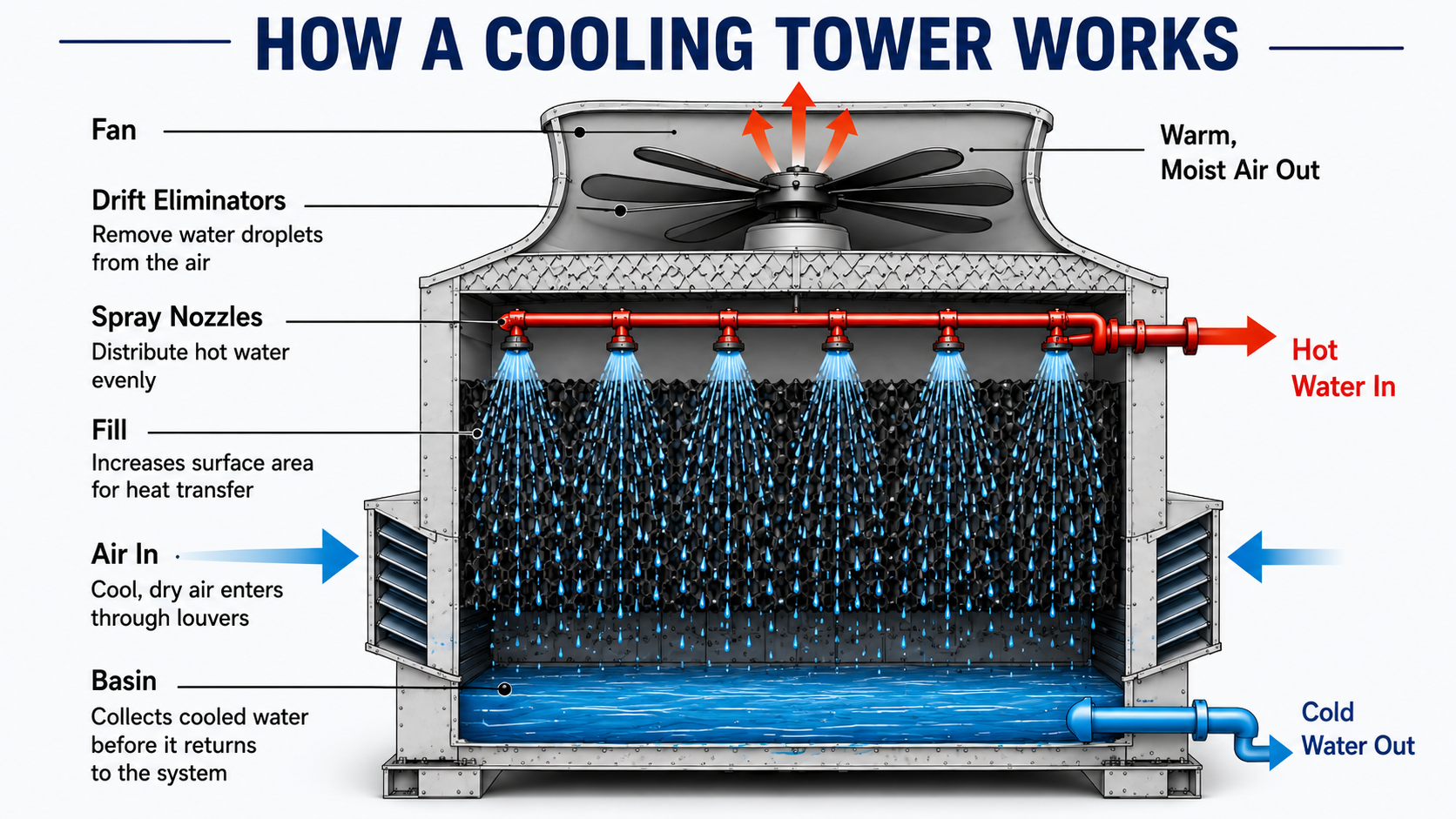
- Hot water enters: Warm condenser water or process water reaches the tower’s distribution system.
- Water is distributed: Spray nozzles or a gravity basin spread water across the fill.
- Air enters the tower: Mechanical or natural draft moves outdoor air through the water path.
- Heat is rejected: Sensible heat moves from the water to the air, and a small portion of the water evaporates and carries away latent heat.
- Cooled water collects: The remaining water falls into the basin and returns to the chiller condenser or process load.
- Water losses are replaced: Makeup water replaces evaporation, drift, blowdown, leakage, and overflow losses.
The visible plume above a cooling tower is not smoke. It forms when warm, moisture-laden discharge air mixes with cooler outdoor air and some of the water vapor condenses into visible droplets.
Cooling Tower Components and Their Functions
A cooling tower operates as one coordinated air, water, heat-transfer, and control system. A problem with a single component can increase leaving-water temperature, water consumption, fan energy, drift, vibration, or maintenance requirements.
Fan, Motor, and Drive
The fan moves air through a mechanical-draft tower. A motor may drive the fan directly or through belts or a gearbox. Variable-frequency drives can adjust fan speed as the heat load and outdoor wet-bulb temperature change.
Fan speed has a strong effect on airflow, sound, and power consumption. Controls should reduce fan speed or stage tower cells without allowing condenser-water temperature to move outside the acceptable range for the connected equipment.
Water-Distribution System
Open crossflow towers commonly use gravity distribution basins above the fill. Counterflow towers generally use pressurized headers and spray nozzles. Uniform distribution matters because dry or overloaded sections of fill reduce effective heat-transfer area.
Fill
Fill increases the contact time and surface area between air and water. Film fill spreads water into thin films and can provide high thermal performance, but its narrow passages may be sensitive to suspended solids, scale, or biological fouling.
Splash fill breaks water into droplets as it falls through successive layers. It may be more tolerant of dirty water or heavy solids, although the best fill depends on water quality, tower design, thermal duty, and maintenance capability.
Drift Eliminators and Louvers
Drift eliminators force leaving air to change direction so entrained droplets fall back into the tower. Louvers help retain water, improve air distribution, reduce splash-out, and limit sunlight while still allowing air to enter.
Cold-Water Basin
The basin collects cooled water and provides operating volume for the condenser-water pump. Typical connections include pump suction, makeup, overflow, drain, equalizer, and blowdown piping. Basin strainers help prevent debris from reaching pumps and downstream heat exchangers.
Makeup and Blowdown Controls
A level-control device admits makeup water as the basin level falls. Blowdown removes a controlled portion of concentrated recirculating water so dissolved minerals do not accumulate indefinitely.
A clean fill pack cannot compensate for blocked nozzles, and a fully operating fan cannot correct poor water flow. Cooling-tower troubleshooting should evaluate water distribution, airflow, heat-transfer surfaces, water chemistry, and system controls together.
Cooling Tower Range, Approach, and Wet-Bulb Temperature
Three temperature relationships explain most cooling-tower performance discussions. Range describes the water temperature change, approach describes how closely the tower reaches the available evaporative-cooling limit, and wet-bulb temperature describes the condition of the entering air.
Cooling Tower Range
Range is the difference between the hot water entering the tower and the cold water leaving it.
At a steady operating condition, range is closely related to heat load and circulating-water flow. A larger heat load generally produces a larger range when water flow remains constant.
Cooling Tower Approach
Approach is the difference between the cold water leaving the tower and the entering-air wet-bulb temperature.
A smaller approach requires the leaving water to operate closer to the wet-bulb temperature. That normally requires more tower capability, more airflow, more heat-transfer surface, lower water loading, or a combination of those factors.
Why Wet-Bulb Temperature Matters
Outdoor dry-bulb temperature describes sensible air temperature. Wet-bulb temperature also reflects the air’s moisture content and its remaining ability to accept additional water vapor. Because a wet cooling tower relies heavily on evaporation, wet bulb is the governing outdoor design condition.
The psychrometric calculator can be used to evaluate wet-bulb temperature and other moist-air properties when the required weather inputs are available.
A wet cooling tower can cool water below the outdoor dry-bulb temperature. Under normal operation, however, the leaving-water temperature remains above the entering-air wet-bulb temperature.
Range and Approach Example
Assume water enters a cooling tower at 95°F, leaves at 85°F, and the entering-air wet-bulb temperature is 78°F.
- Range: 95°F − 85°F = 10°F
- Approach: 85°F − 78°F = 7°F
The 10°F range is the water temperature reduction through the tower. The 7°F approach shows how close the leaving water is to the entering-air wet-bulb temperature. These values describe the operating point, but they do not by themselves prove that the tower is correctly selected or operating efficiently.
Cooling Tower Types Explained
Cooling towers are classified in several independent ways. A single tower can be open circuit, counterflow, induced draft, and factory assembled at the same time. Keeping the classification layers separate makes equipment comparisons clearer.
Open-Circuit Cooling Tower
In an open tower, the recirculating system water directly contacts outdoor air. This arrangement provides effective evaporative heat rejection with relatively simple equipment, but the circulating water is exposed to airborne debris, dissolved minerals, microorganisms, and treatment chemicals.
Closed-Circuit Cooling Tower
A closed-circuit tower keeps the process fluid inside a coil. External spray water flows over the coil while air moves through the unit. The process loop remains isolated, but the spray-water system is still open to the atmosphere and still requires water treatment, cleaning, and biological control.
Induced-Draft Cooling Tower
An induced-draft tower places the fan at the air discharge. The fan pulls air through the tower and creates a relatively high-velocity discharge that helps carry warm, humid air away from the inlets. This is a common arrangement in commercial HVAC systems.
Forced-Draft Cooling Tower
A forced-draft tower places the fan at the air inlet and pushes air through the tower. The fan operates in cooler entering-air conditions, but the discharge arrangement can be more susceptible to recirculation when tower placement and surrounding clearances are poor.
Natural-Draft Cooling Tower
Natural-draft towers use buoyancy created by differences in air density rather than mechanical fans. Large hyperbolic towers are recognizable examples, but they represent a specialized application and are not typical rooftop or commercial-building cooling towers.
| Classification | Operating Method | Typical Advantage | Primary Consideration |
|---|---|---|---|
| Open circuit | System water directly contacts outdoor air | Simple, effective evaporative heat rejection | Water treatment, contamination, corrosion, and fouling |
| Closed circuit | Process fluid remains inside a coil while spray water evaporates outside it | Isolates the process-fluid loop | Additional coil resistance, complexity, and spray-water treatment |
| Induced draft | A discharge fan pulls air through the tower | Strong discharge and broad HVAC applicability | Fan, drive, vibration, and discharge clearances |
| Forced draft | An inlet fan pushes air through the tower | Fan operates in cooler entering air | Air distribution and discharge recirculation |
| Natural draft | Buoyancy produces airflow without a mechanical fan | No normal fan-energy requirement | Physical size, structure, climate, and application scale |
No classification is automatically best. The appropriate tower depends on thermal duty, fluid-isolation requirements, site constraints, water quality, energy objectives, maintenance capability, sound, climate, water availability, and life-cycle cost.
Crossflow vs. Counterflow Cooling Towers
Crossflow and counterflow describe the direction of airflow relative to the falling water. They do not indicate whether a tower is open or closed circuit, nor whether its fan arrangement is induced or forced draft.

Crossflow Tower Operation
Water typically enters an open gravity basin above the fill and falls downward. Air enters through the side and travels horizontally across the water path. The gravity distribution system can reduce required distribution pressure and can make the upper basin and distribution openings easier to inspect while the tower is operating.
Counterflow Tower Operation
Water falls vertically while air travels upward in the opposite direction. Pressurized headers distribute water above the fill, and drift eliminators are commonly positioned above the spray system. The arrangement can provide a compact plan footprint, although water-distribution pressure and internal maintenance access must be considered.
Which Configuration Fits the Project?
Crossflow units are often attractive where gravity distribution, lower distribution head, and accessible upper basins are important. Counterflow units are often attractive where plan area is constrained or a proposed model provides a favorable certified operating point.
The final comparison should use model-specific data for thermal performance, fan power, pump head, sound, physical dimensions, operating weight, winter operation, and service access. Broad statements that one configuration is always more efficient are not reliable enough for final selection.
Cooling Tower Selection Guide
Cooling tower selection begins with the required operating point, not with a generic tonnage label. Use this workflow to narrow the equipment family before comparing certified manufacturer selections.

- Define the heat-rejection duty: Determine the total condenser or process heat that the tower must reject, including heat added by the connected equipment.
- Set the thermal design point: Establish hot-water temperature, required cold-water temperature, water flow, design entering-air wet-bulb temperature, and site elevation.
- Decide whether the process fluid may be exposed: Consider an open circuit when direct air contact is acceptable and a closed circuit when process-fluid isolation is important.
- Review water conditions: Consider hardness, suspended solids, biological loading, makeup-water quality, treatment capability, water availability, and discharge restrictions.
- Evaluate the site: Check footprint, height, structural support, rigging access, service clearances, prevailing wind, nearby walls, outdoor-air intakes, and recirculation risk.
- Set operating priorities: Compare fan energy, pump head, water consumption, sound, plume, redundancy, winter operation, maintainability, and expected service life.
- Compare certified selections: Review performance at the exact design point and at meaningful part-load and off-design conditions.
- Coordinate the complete system: Confirm pumps, controls, basin volume, piping elevations, equalizers, isolation, freeze protection, makeup, blowdown, and water treatment.
Information Needed for Equipment Selection
- Required heat-rejection duty
- Entering and leaving water temperatures
- Design water flow rate
- Entering-air wet-bulb temperature
- Site elevation
- Allowable fan power and sound limits
- Available electrical service
- Makeup-water quality and proposed treatment strategy
- Required materials of construction
- Maximum dimensions and operating weight
- Redundancy, cell arrangement, and turndown requirements
- Winter design conditions and freeze-protection strategy
Nominal cooling-tower tons do not replace a project-specific selection. Two towers with the same nominal rating can perform differently at the project’s actual wet bulb, approach, flow, elevation, sound limit, and fan-power requirement.
Cooling Tower Siting, Piping, and Controls
A thermally adequate tower can still perform poorly when its location, piping, or control sequence is not coordinated with the rest of the HVAC system.
Air Recirculation
Warm, moisture-laden discharge air should be able to rise and move away from the tower. Nearby walls, screens, roofs, exhausts, structural obstructions, and prevailing winds can redirect discharge air back toward the inlets.
Recirculation raises the effective entering-air wet-bulb temperature and can cause leaving-water temperature to rise even when the tower fan, fill, and water distribution appear normal.
Building Air Intakes and Occupied Areas
Tower discharge, drift, chemical odors, sound, and maintenance activity should be considered when locating towers near outdoor-air intakes, operable windows, roofs, walkways, property lines, and occupied areas.
Condenser-Water Piping
Piping design should coordinate pump suction conditions, tower elevation, static head, pressure losses, basin drawdown, equalizer piping, overflow routing, isolation, drainage, and startup or shutdown behavior. Multiple-cell towers require careful balancing so cells receive appropriate water flow.
Control Sequence
A typical control strategy modulates fan speed or stages tower cells to maintain a condenser-water temperature target. The target may reset with load or outdoor conditions, but it must remain within the operating limits of the chiller or process equipment.
Check the complete operating sequence at maximum load, minimum load, startup, shutdown, cell isolation, low outdoor temperature, and loss of a fan or pump. A control sequence that works only at the design point is incomplete.
Cooling Tower Water Use and Water Treatment
A cooling tower continuously changes the chemistry of its recirculating water. Evaporation removes relatively pure water vapor while most dissolved minerals remain behind. Without controlled blowdown and treatment, mineral concentration, scale, corrosion, fouling, and biological growth can increase.
Makeup, Evaporation, Drift, and Blowdown
- Evaporation: Water converted to vapor as heat is rejected.
- Drift: Liquid droplets carried out with the leaving airstream.
- Blowdown: Water intentionally discharged to control dissolved-solids concentration.
- Makeup: New water added to replace evaporation, drift, blowdown, leaks, and overflow.
Cycles of Concentration
Cycles of concentration compare the dissolved-solids concentration in recirculating tower water with the concentration in makeup water. Increasing cycles can reduce blowdown, but excessive concentration can increase scale, corrosion, and treatment difficulty.
The appropriate operating range depends on makeup-water chemistry, tower materials, heat-exchanger requirements, treatment strategy, discharge limits, and the water-treatment provider’s control plan.
Scale, Corrosion, and Fouling
Scale adds thermal resistance and can restrict fill, nozzles, strainers, piping, and heat exchangers. Corrosion weakens metal components and introduces corrosion products into the system. Sediment, airborne debris, and biological material can block water and airflow paths.
Side-Stream Filtration
Side-stream filtration removes a portion of suspended material from the recirculating water. It can reduce basin sediment and solids loading, but it does not replace chemical treatment, biological control, blowdown, inspection, or physical cleaning.
Legionella Water Management
Cooling towers can generate aerosols and require a site-specific water-management program. Control measures commonly address sediment, biofilm, scale, corrosion, disinfectant residual, stagnation, cleaning, operating records, drift elimination, and response procedures.
Both open- and closed-circuit evaporative towers contain external recirculating water that contacts air. Closed circuit describes isolation of the process fluid; it does not eliminate the need to manage the tower’s spray-water system.
Cooling Tower Operation, Maintenance, and Troubleshooting
Cooling-tower performance problems usually result from changes in airflow, water distribution, heat-transfer surfaces, entering conditions, controls, or system flow. Begin troubleshooting by measuring the current operating point rather than relying only on visual inspection.
| Observed Problem | Likely Causes | First Checks | Potential Consequence |
|---|---|---|---|
| Cold-water temperature is too high | High wet bulb, excessive heat load, low airflow, recirculation, fouled fill, poor distribution, or incorrect water flow | Measure temperatures and flow; inspect fan operation, fill, nozzles, and surrounding airflow | Higher condenser pressure and reduced chiller efficiency or capacity |
| Uneven water flow over fill | Clogged nozzles, an unlevel basin, low pressure, blocked openings, or poor balancing | Inspect the water-distribution pattern using appropriate access and safety procedures | Dry fill sections, reduced thermal performance, and localized scaling |
| Excessive drift | Damaged, missing, fouled, or incorrectly installed drift eliminators; excessive airflow | Inspect eliminators and confirm fan operating condition | Water loss, chemical deposition, and increased aerosol release |
| High vibration or unusual noise | Fan imbalance, damaged blades, bearing wear, loose supports, gearbox problems, or misalignment | Shut down as required and inspect the fan, drive, motor, bearings, and structure | Mechanical damage and unsafe operation |
| Scale or biological growth | Inadequate treatment, poor blowdown control, warm stagnant zones, sunlight, or high solids loading | Review water records and inspect the basin, fill, nozzles, strainers, and eliminators | Restricted flow, reduced heat transfer, corrosion, and biological risk |
| Basin level is unstable | Incorrect makeup control, blocked strainer, poor equalization, excessive drawdown, overflow, or piping drainage | Observe level during startup and shutdown; inspect valves, equalizers, overflow, and suction conditions | Air entrainment, pump cavitation, water loss, or overflow |
| Winter icing | Low heat load, poor distribution, excessive airflow, wind exposure, or an unsuitable control sequence | Verify fan staging, water distribution, basin heating, bypass operation, and manufacturer procedures | Restricted airflow, structural loading, damaged fill, and hazardous falling ice |
Routine Inspection Checklist
- Check fan blades, motor, gearbox or belts, bearings, guards, and vibration.
- Verify uniform water distribution and clear blocked spray nozzles or basin openings.
- Inspect fill and drift eliminators for scale, damage, blockage, and biological growth.
- Remove basin debris and inspect strainers, makeup controls, overflow, drain, and blowdown connections.
- Review water-treatment records, conductivity control, disinfectant control, makeup, and blowdown operation.
- Check casing, supports, fasteners, ladders, platforms, rails, seals, and structural corrosion.
- Confirm that discharge air is not being drawn back into tower inlets or nearby outdoor-air intakes.
- Test fan-speed control, cell staging, alarms, basin heaters, and freeze-protection sequences.
A tower may have a running fan and visible spray yet still perform poorly. Confirm water flow, hot-water temperature, cold-water temperature, entering-air wet bulb, fan speed, and distribution before concluding that the tower lacks capacity.
Cooling Tower Applications and Design Review
Cooling towers serve systems that must reject substantial heat while achieving water temperatures closer to outdoor wet bulb than a practical dry-air system can normally provide.
Commercial Buildings and Campuses
Office buildings, hospitals, airports, universities, and district energy plants commonly use towers with central water-cooled chillers. Important issues include redundancy, sound, outdoor-air intake separation, plume, structural loading, water treatment, maintenance access, and condenser-water controls.
Data Centers
Data-center heat-rejection systems place high value on reliability, water availability, energy use, maintainability, redundancy, and transitions between economizer and mechanical-cooling modes. The preferred solution depends on climate, owner objectives, and the complete cooling architecture.
Industrial Processes
Manufacturing, chemical processing, power generation, food processing, and refrigeration systems may use cooling towers for process heat exchangers or condensers. Water chemistry, process contamination, materials, temperature limits, turndown, and year-round operation may control the design.
Cooling Tower Design-Review Checklist
- Does the selected duty include all heat that reaches the condenser-water or process-water loop?
- Are wet-bulb temperature, elevation, range, approach, and water flow based on the project design criteria?
- Can discharge air escape without recirculating into tower inlets or entering building ventilation intakes?
- Are service clearances, rigging paths, ladders, platforms, fan access, and component-removal routes adequate?
- Can each cell be isolated, drained, cleaned, and maintained without unacceptable system downtime?
- Are basin volume, piping drainage, equalizers, pump suction, overflow, and startup drawdown coordinated?
- Are sound, vibration, drift, plume, chemical discharge, and visible-location requirements addressed?
- Does the control sequence cover fan speed, cell staging, low-load operation, temperature reset, alarms, and freezing conditions?
- Is there a complete water-treatment and Legionella water-management plan?
- Has final performance been verified using certified manufacturer data at the exact design point?
Cooling Tower Engineering References
These references support the operating principles, classifications, selection factors, maintenance considerations, and water-management guidance used on this page.
- ASHRAE Handbook: Cooling Towers Cooling-tower operation, design conditions, range, approach, classifications, capacity control, siting, and maintenance.
- CDC: Controlling Legionella in Cooling Towers Water-management programs, sediment and biofilm control, disinfectant monitoring, stagnation, cleaning, recordkeeping, and response planning.
- National Laboratory of the Rockies: Cooling Tower Resource Cooling-tower configurations, airflow arrangements, operating characteristics, and practical equipment comparisons.
Frequently Asked Questions
A wet cooling tower can cool water below the outdoor dry-bulb temperature because evaporation is governed by wet-bulb conditions. The leaving-water temperature normally remains above the entering-air wet-bulb temperature, with the difference called the approach.
A chiller uses a refrigeration cycle to remove heat from chilled water. In a water-cooled system, the cooling tower rejects the chiller’s condenser heat to outdoor air by cooling the circulating condenser water.
Makeup water replaces water lost through evaporation, blowdown, drift, leaks, and occasional overflow. Evaporation is necessary for heat rejection, while blowdown controls the buildup of dissolved minerals in the recirculating water.
Range is the entering hot-water temperature minus the leaving cold-water temperature. Approach is the leaving cold-water temperature minus the entering-air wet-bulb temperature. Range relates strongly to heat load and water flow, while approach indicates how closely the tower reaches the evaporative-cooling limit.
No. The process fluid remains isolated inside a coil, but the external spray-water circuit still contacts outdoor air and can generate aerosols. Closed-circuit towers therefore still require water treatment, cleaning, drift control, monitoring, and an appropriate water-management program.
Summary and Next Steps
A cooling tower rejects condenser or process heat by bringing circulating water and outdoor air into direct or indirect thermal contact. Understanding the water path, airflow path, fill, wet-bulb limitation, range, approach, and tower classifications makes equipment selection and performance troubleshooting easier.
Begin selection with required heat rejection, water flow, entering and leaving temperatures, and design wet-bulb temperature. Then evaluate fluid isolation, footprint, water quality, energy, sound, plume, winter operation, maintenance, and life-cycle cost before confirming the choice with certified manufacturer data.
Where to Go Next
-
Chiller System
See how the cooling tower, condenser-water loop, refrigerant cycle, and chilled-water loop work together.
-
Psychrometric Calculator
Evaluate wet-bulb temperature and other moist-air properties used in evaporative heat rejection.
-
Sensible Heat vs. Latent Heat
Understand the two heat-transfer effects involved as tower water cools and a portion evaporates.