
Table of Contents
Introduction
A MERV rating, or Minimum Efficiency Reporting Value, describes how effectively an HVAC filter captures particles from 0.3 to 10 micrometers. Higher ratings capture a greater share of smaller particles, but the right choice is the highest useful efficiency that fits the equipment and maintains acceptable airflow and system performance.
For many homes and light-commercial systems, the practical comparison is MERV 8 versus MERV 11 versus MERV 13. MERV 8 provides general filtration, MERV 11 adds measurable capture in the smallest MERV test range, and MERV 13 provides a substantial increase in fine-particle capture when the HVAC system can accommodate the specific filter.
Key Takeaways
- What MERV means: It compares filter capture performance for tested particles between 0.3 and 10 micrometers.
- Common residential choices: MERV 8, 11, and 13 represent meaningful steps in progressively smaller-particle capture.
- Best practical choice: Use the highest useful efficiency your equipment, fan, filter slot, and duct system can support.
- Critical limitation: MERV does not directly tell you pressure drop, filter life, gas removal, energy use, or installed-system performance.
What a MERV Rating Measures
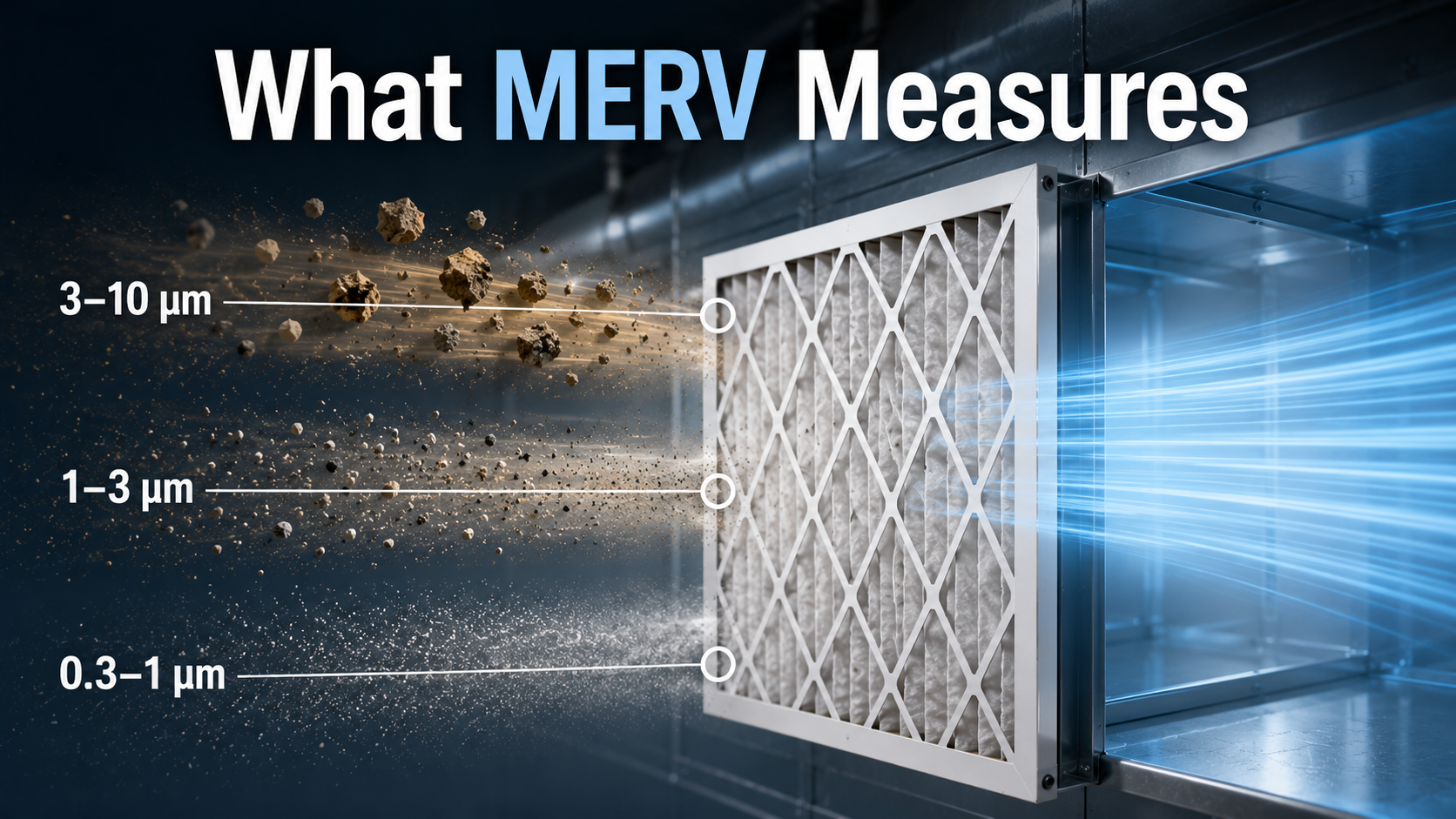
A MERV rating summarizes measured average capture efficiency. It does not mean that the filter captures every particle in a listed size range, and it does not predict the concentration of particles that will remain in a specific room.
Quick MERV Selection Guide
Start with the filtration goal, then verify equipment compatibility. These ranges are useful orientation points, not universal prescriptions.
MERV 8: General Filtration
MERV 8 is a common baseline for pleated HVAC filters. It provides meaningful capture of larger airborne particles and begins reporting performance in the 1–3 micrometer range. It may suit systems where general dust and pollen control is the main goal or where equipment limitations prevent a higher-efficiency filter.
MERV 11: Stronger Fine-Particle Capture
MERV 11 provides a clear step up from MERV 8. It is the first rating with a stated minimum efficiency in the 0.3–1.0 micrometer test range and can be a useful middle option when stronger filtration is wanted but MERV 13 compatibility is uncertain.
MERV 13: Higher-Efficiency HVAC Filtration
MERV 13 captures at least half of the particles in the 0.3–1.0 micrometer test range under the standard test framework. EPA recommends MERV 13, or the highest rating the system fan and filter slot can accommodate, when upgrading central HVAC filtration.
If the equipment documentation permits MERV 13 and the specific filter maintains acceptable airflow and static pressure, MERV 13 is usually the strongest of these three choices. When compatibility is uncertain, verify performance rather than assuming the rating is either safe or too restrictive.
How the MERV Scale Works
MERV stands for Minimum Efficiency Reporting Value. The rating is derived from the ASHRAE Standard 52.2 test method and is used to compare filters installed in furnaces, central air conditioners, air handlers, rooftop units, and other HVAC systems.
The familiar MERV scale runs from 1 through 16. As the rating rises, the filter must demonstrate stronger minimum average efficiency against progressively smaller particle sizes. The numerical steps are not evenly spaced in practical importance, which is why certain ratings are discussed more often than others.
The Three MERV Particle-Size Groups
- E3: 3.0–10.0 µm. The largest test range. It includes the general size range of many larger dust particles, lint, pollen fragments, and other coarse airborne debris.
- E2: 1.0–3.0 µm. An intermediate range containing particles that are more difficult to capture than the larger E3 group.
- E1: 0.3–1.0 µm. The smallest MERV test range and an important differentiator among higher-efficiency filters.
The Most Important Breakpoints
- MERV 8: Introduces a stated minimum efficiency in the 1–3 µm range.
- MERV 11: Introduces a stated minimum efficiency in the 0.3–1.0 µm range.
- MERV 13: Reaches at least 50% average efficiency in the 0.3–1.0 µm range.
- MERV 16: Reaches at least 95% average efficiency in all three MERV particle-size ranges.
A MERV number is a tested performance classification, not a list of individual contaminants. Real particles vary in diameter, shape, density, composition, charge, and behavior, so use particle examples only to understand scale.
MERV Rating Chart: 1 Through 16
Use the chart to identify where each rating begins reporting meaningful performance in the three tested particle-size ranges. “Not rated” means the rating has no required minimum average efficiency for that particle band.
| MERV rating | 0.3–1.0 µm | 1.0–3.0 µm | 3.0–10.0 µm | How to interpret it |
|---|---|---|---|---|
| 1–4 | Not rated | Not rated | Less than 20% | Basic filtration of larger debris, primarily supporting equipment cleanliness rather than fine-particle control. |
| 5 | Not rated | Not rated | At least 20% | Beginning of stated minimum performance in the largest MERV particle range. |
| 6 | Not rated | Not rated | At least 35% | Improved capture of larger particles compared with lower-efficiency panel filters. |
| 7 | Not rated | Not rated | At least 50% | Moderate large-particle filtration without a required E2 or E1 minimum. |
| 8 | Not rated | At least 20% | At least 70% | Common general-purpose pleated-filter level with measured E2 and E3 performance. |
| 9 | Not rated | At least 35% | At least 75% | Improved intermediate-particle capture compared with MERV 8. |
| 10 | Not rated | At least 50% | At least 80% | Stronger E2 performance while maintaining high E3 capture. |
| 11 | At least 20% | At least 65% | At least 85% | First rating with a stated minimum in the smallest E1 test range. |
| 12 | At least 35% | At least 80% | At least 90% | Higher capture across all three particle-size ranges. |
| 13 | At least 50% | At least 85% | At least 90% | Substantial fine-particle filtration when the system can accommodate the specific filter. |
| 14 | At least 75% | At least 90% | At least 95% | High-efficiency filtration for systems and applications designed for greater resistance and tighter control. |
| 15 | At least 85% | At least 90% | At least 95% | Very high performance throughout the MERV test ranges. |
| 16 | At least 95% | At least 95% | At least 95% | Highest rating on the standard MERV 1–16 scale, but still not equivalent to HEPA classification. |
The chart shows why a single statement such as “higher MERV captures smaller particles” is incomplete. The most useful comparison is the efficiency required within each tested size band, especially the E1 range when fine-particle filtration is the goal.
MERV 8 vs. MERV 11 vs. MERV 13
These three ratings are frequently compared because each marks a meaningful change in tested performance. The correct selection depends on the filtration objective and whether the specific filter can operate within the HVAC system’s airflow and pressure limits.

MERV 8 Performance
MERV 8 captures at least 70% of the 3–10 µm test range and at least 20% of the 1–3 µm range. It can be a practical option for general dust and larger-particle control, especially in equipment that is not intended for a higher-resistance filter.
MERV 11 Performance
MERV 11 captures at least 20% of the 0.3–1.0 µm range, at least 65% of the 1–3 µm range, and at least 85% of the 3–10 µm range. It provides a meaningful increase in finer-particle capture without moving directly to MERV 13.
MERV 13 Performance
MERV 13 captures at least 50% of the 0.3–1.0 µm range, at least 85% of the 1–3 µm range, and at least 90% of the 3–10 µm range. It is the commonly recommended upgrade target when the HVAC equipment, filter slot, and fan can accommodate the specific filter.
Do not compare MERV numbers without comparing the actual filters. A low-resistance MERV 13 filter with a large media area may create less pressure drop than a poorly designed filter with a lower rating.
How to Choose the Right MERV Rating
Use this five-step process to move from an air-quality goal to a filter selection that works in the installed HVAC system.

- Define the filtration objective: Decide whether the priority is basic equipment protection, general dust and pollen control, stronger allergen and fine-particle capture, or improved control of smoke-related particles.
- Review the equipment requirements: Check the furnace, air handler, rooftop unit, return grille, or filter cabinet documentation for the approved filter dimensions, depth, configuration, and manufacturer guidance.
- Compare specific filter data: Review pressure-drop data at the system’s expected airflow when the manufacturer provides it. Do not assume every filter with the same MERV rating has the same resistance.
- Verify operating performance: Confirm that delivered airflow, total external static pressure, furnace temperature rise, coil performance, comfort, and noise remain acceptable.
- Inspect and maintain the installation: Verify the airflow direction, rack fit, access-panel closure, edge seal, filter condition, and replacement schedule.
Example: Upgrading From MERV 8 to MERV 13
A homeowner currently uses a 1-inch MERV 8 filter and wants better fine-particle capture. A MERV 13 filter may be appropriate, but the MERV number alone cannot confirm the upgrade.
First, the equipment documentation and filter rack should be checked. Next, the clean-filter pressure drop of the proposed MERV 13 product should be compared at the expected system airflow. After installation, airflow or static pressure should be verified when there is any concern about compatibility. The filter should then be inspected as it loads because operating resistance changes over time.
If the 1-inch MERV 13 filter creates excessive resistance, the answer is not necessarily to abandon MERV 13. A deeper media cabinet, larger filter face area, lower-resistance product, duct correction, or blower adjustment may provide a better path, subject to the equipment manufacturer’s requirements.
The correct question is: “Can this HVAC system deliver its required airflow with this specific filter at clean and expected loaded conditions?”
MERV Rating, Airflow, and Pressure Drop
Air must pass through the filter before reaching the blower, heat exchanger, evaporator coil, or supply duct system. The filter creates resistance, which appears as a pressure drop. The blower must overcome this resistance along with losses through ducts, fittings, grilles, dampers, coils, and other components.
If the total resistance exceeds what the system can accommodate, delivered airflow can fall. That is why filter selection is an HVAC system decision rather than a stand-alone indoor-air-quality decision.
What Controls Filter Pressure Drop?
- Airflow rate: More air moving through the same filter area generally increases pressure drop.
- Filter face area: A larger face area reduces the average face velocity for the same total airflow.
- Media area: Additional pleated media can spread airflow over a larger effective surface.
- Media construction: Fiber structure, electrostatic properties, support layers, and manufacturing quality influence resistance.
- Pleat geometry: Pleat depth, spacing, and shape affect how much media is usable and how evenly air moves through it.
- Dust loading: Accumulated material changes resistance during the filter’s service life.
- Installation quality: Bent filters, damaged frames, collapsed media, and bypass gaps change real performance.
Possible Effects of Excessive Filter Resistance
- Reduced heating or cooling airflow at supply registers
- Longer equipment run times and uneven comfort
- Elevated furnace temperature rise
- Reduced heat transfer across heating or cooling coils
- Evaporator-coil icing risk under some cooling conditions
- Additional blower noise or control issues
- Reduced ability to balance airflow throughout the duct system
For a broader explanation of duct airflow, friction, velocity, and available static pressure, review the Fluid Mechanics guide. When evaluating duct dimensions, the Duct Size Calculator can support preliminary airflow and velocity checks, although final HVAC design must include filters, coils, fittings, leakage, noise, and fan performance.
A filter can fit physically and still be a poor operating match. Filter dimensions verify fit; they do not verify acceptable airflow or pressure drop.
Filter Depth, Fit, and Installation
The printed MERV number matters only when the HVAC air is directed through the filter media. Filter depth, surface area, rack condition, orientation, and sealing all influence installed performance.
1-Inch vs. Deeper Media Filters
A deeper pleated filter often contains more media area than a 1-inch filter with the same face dimensions. More media area can allow stronger particle capture at a lower face velocity through the media. This can help reduce pressure drop, increase dust-holding capacity, or extend service life.
However, filter depth alone does not prove that one product has lower resistance than another. Compare product data at the intended airflow rather than assuming every 4-inch filter outperforms every 1-inch filter.
Nominal vs. Actual Filter Size
Retail filters are often identified by a nominal size, while their actual dimensions are slightly smaller. Replace the filter with the size specified for the equipment or cabinet and verify that the frame seats correctly. A loose filter may allow bypass; an oversized filter may deform or prevent the access panel from closing.
Follow the Airflow Arrow
Install the filter so the arrow points in the direction of airflow, normally toward the blower or air-handling equipment. Do not rely only on the physical direction the filter is facing; confirm where return air enters and where it travels next.
Control Filter Bypass
Inspect the rack, retaining clips, access door, gaskets, and edge clearances. Dust tracks around the frame can indicate that air is passing around the filter instead of through it. Bypass leakage can reduce filtration effectiveness even when the filter media has a high MERV rating.
When replacing a filter, photograph the installed airflow arrow and record the filter’s exact dimensions and installation date. This makes future replacement faster and reduces the chance of installing the wrong size or direction.
MERV vs. HEPA, MPR, and FPR
MERV, HEPA, MPR, and FPR are different classifications. Avoid unsupported conversion charts that imply each number has an exact equivalent on the other scales.
| Rating or classification | What it describes | Where it is used | Main limitation |
|---|---|---|---|
| MERV | Average particle-capture performance across defined size ranges under the ASHRAE test method. | Residential, commercial, institutional, and industrial HVAC filters. | Does not directly state pressure drop, gas removal, installed efficiency, energy use, or filter life. |
| HEPA | A separate high-efficiency classification commonly defined as at least 99.97% efficiency at 0.3 µm. | Portable air cleaners and specialized systems designed for HEPA filtration. | HEPA is not part of the MERV scale and should not be assumed suitable for a standard furnace filter slot. |
| MPR | A proprietary microparticle performance rating used by a filter manufacturer. | Consumer HVAC filter packaging and product listings. | It is not the ASHRAE MERV scale, and comparisons should use manufacturer-supported documentation. |
| FPR | A proprietary retail filter performance rating. | Consumer filter packaging and retail product comparisons. | It does not have a universal one-to-one conversion to MERV. |
MERV is generally the most useful common reference for central HVAC filtration because it connects to a recognized test method. The rating should still be paired with the filter manufacturer’s airflow and pressure-drop information.
MERV 16 is not HEPA. EPA lists HEPA separately and notes that the HEPA efficiency value is not based on the MERV rating system.
Common MERV Rating Mistakes
These mistakes can reduce filtration performance, create unnecessary HVAC problems, or make a filter upgrade less useful than expected.
- Assuming the highest number is always best: Higher efficiency only helps when the system can maintain acceptable airflow with the selected filter.
- Comparing MERV without comparing resistance: Filters with the same rating can have different clean and loaded pressure drops.
- Confusing MERV 13 with HEPA: MERV and HEPA are separate classifications with different performance and system-design implications.
- Installing the filter backward: Incorrect orientation may reduce support or cause the filter to perform differently than intended.
- Allowing air to bypass the frame: Unsealed gaps allow particles to travel around the media.
- Using the wrong nominal size: Similar-looking filters may have different actual dimensions and may not seat correctly.
- Waiting only for visible dirt: Appearance alone does not reveal pressure drop or system airflow.
- Replacing on a universal calendar: Loading depends on filter area, runtime, pets, occupancy, smoke, dust, construction, and air leakage.
- Expecting particle filtration to remove gases: MERV does not rate removal of odors, gaseous contaminants, or most volatile organic compounds.
- Running the fan rarely: A central filter only removes particles from air that actually passes through the HVAC system.
A high-MERV filter in a leaky rack may provide less real benefit than a properly fitted and sealed filter with a lower rating. Installed performance depends on the complete airflow path.
How Often Should a MERV Filter Be Replaced?
There is no replacement interval that works for every filter, system, and building. Follow the filter and HVAC equipment manufacturer’s instructions, then adjust inspection frequency for actual conditions.
Conditions That Can Load a Filter Faster
- Heavy heating or cooling runtime
- Pets, high occupancy, or elevated indoor particle generation
- Wildfire smoke, dust storms, nearby traffic, or outdoor construction
- Interior renovation, sanding, cutting, or drywall work
- A relatively small filter area serving a high airflow
- Duct leakage that draws dust from an attic, crawlspace, garage, or wall cavity
- Operating the circulation fan for longer periods to increase filtration
Filter Inspection Checklist
- Confirm that the media has not collapsed, torn, bowed, or separated from the frame.
- Verify that the filter remains seated and that the access panel closes securely.
- Look for dust tracks or edge gaps that may indicate bypass leakage.
- Check whether supply airflow, comfort, noise, or equipment behavior has changed.
- Review the recorded installation date and operating conditions since replacement.
- Measure filter pressure drop or system airflow when loading or compatibility is uncertain.
EPA notes that many filter manufacturers commonly recommend replacement approximately every 60 to 90 days. That interval is general consumer guidance, not a universal engineering requirement. Some filters need earlier replacement, while large deep-media filters may have a different service interval.
Inspect a newly selected filter after the first month of operation. The early check helps reveal unusual loading, deformation, bypass, noise, or airflow changes before the filter remains in service for an extended period.
What a MERV Rating Does Not Tell You
MERV is useful because it standardizes one important characteristic: particle-capture performance. It should not be treated as a complete indoor-air-quality or HVAC-performance score.
Pressure Drop
The MERV number does not directly tell you how much resistance a filter creates at a specific airflow. Use product performance data or field measurements.
Gas and Odor Removal
MERV evaluates particle filtration. Odors, ozone, gaseous contaminants, and many volatile organic compounds require source control, ventilation, suitable sorbent media, or another treatment method.
Room Particle Concentration
A filter’s test efficiency does not by itself determine room air quality. Results also depend on particle sources, outdoor-air entry, building leakage, fan runtime, filter bypass, air mixing, deposition, ventilation, and portable air cleaners.
Health Outcomes
A MERV rating describes filter performance, not a guaranteed health outcome. Filtration can be one part of a broader indoor-air-quality strategy that also includes source control, ventilation, moisture management, cleaning, and equipment maintenance.
Filter Life
Two filters with the same MERV rating can have different media areas, dust-holding capacities, pressure-drop curves, and replacement needs.
For related thermal-system context, review the guides to Heat Transfer and Heat Exchangers. These topics help explain why airflow, surface condition, pressure drop, and fouling matter to HVAC equipment performance.
MERV Rating Standards and References
These official resources support the MERV definition, particle-capture values, selection guidance, and distinction between MERV and HEPA filtration.
- U.S. EPA: What Is a MERV Rating? Supports the MERV definition, MERV 1–16 particle-efficiency chart, MERV 13 upgrade guidance, replacement requirement, and HEPA comparison.
- U.S. EPA: Guide to Air Cleaners in the Home Supports filter selection, correct fit, system compatibility, operating considerations, maintenance, and the limitations of residential air cleaning.
- ASHRAE Filtration and Disinfection Resources Provides engineering context for HVAC filtration and the ASHRAE framework associated with MERV testing and application.
Frequently Asked Questions
Use the highest useful efficiency that your HVAC equipment, fan, filter slot, and duct system can accommodate. EPA recommends MERV 13, or the highest rating the system can support, when upgrading central HVAC filtration. Verify manufacturer guidance and airflow when compatibility is uncertain.
No. A higher rating means stronger capture of tested particle sizes, but it is only a better choice when the filter fits correctly and the system can maintain acceptable airflow, pressure, heating, cooling, comfort, and equipment operation.
Not automatically. Some residential systems can accommodate a properly designed MERV 13 filter, while others cannot. Check the equipment documentation, filter size and depth, product pressure-drop data, airflow, and total external static pressure before upgrading.
MERV 8 has required performance in the 1–3 and 3–10 µm ranges. MERV 11 adds required performance in the 0.3–1.0 µm range. MERV 13 raises minimum capture in that smallest range to at least 50%.
No. HEPA is a separate high-efficiency classification commonly defined as at least 99.97% efficiency at 0.3 µm. It is not part of the MERV scale and usually requires equipment designed for its resistance, media depth, sealing, and airflow needs.
Higher-MERV filters can capture a portion of fine particles associated with smoke when those particles pass through the filter. They do not remove every smoke particle, and standard particle filters do not necessarily remove smoke odors or gaseous contaminants.
MERV describes particle capture, not gas removal. Odors, gaseous contaminants, and many volatile organic compounds require source control, ventilation, appropriate sorbent media, or another treatment method intended for those contaminants.
Follow the filter and equipment manufacturer’s instructions and inspect more frequently during heavy HVAC use, wildfire smoke, construction, high dust, or pet-related loading. A monthly visual and fit check is a useful starting habit when evaluating a new filter or operating condition.
Summary and Next Steps
A MERV rating compares how effectively an HVAC filter captures particles between 0.3 and 10 micrometers. MERV 8, 11, and 13 are common comparison points because each represents a meaningful increase in the capture of smaller particles.
For many systems, MERV 13 is the preferred upgrade target when the equipment can accommodate the specific filter. The final choice should also account for filter dimensions, depth, pressure drop, airflow, fan capacity, rack sealing, loading, and replacement practices.
Where to Go Next
-
HVAC Engineering Resources
Continue with HVAC system, equipment, airflow, load, and indoor-air-quality topics.
-
Duct Size Calculator
Estimate preliminary duct area and dimensions from airflow and target velocity, then check static pressure and system constraints.
-
Fluid Mechanics
Build the airflow and pressure foundation needed to understand filters, ducts, fans, and HVAC resistance.