
Table of Contents
Introduction
A SEER rating measures the seasonal cooling efficiency of an air conditioner or heat pump. It compares the total heat removed during a standardized cooling season, in Btu, with the electrical energy consumed, in watt-hours. A higher SEER or SEER2 rating means lower rated electricity use for the same seasonal cooling output.
Current residential equipment is generally compared using SEER2, the rating produced under the newer U.S. Department of Energy Appendix M1 test procedure. SEER2 is useful for comparing equipment, but it does not predict an exact utility bill or guarantee that an installed system will perform at its laboratory rating.
Key Takeaways
- Core idea: SEER2 compares seasonal cooling delivered with the electrical energy required to provide it.
- Current metric: SEER2 uses the updated Appendix M1 test procedure and should be used for current equipment comparisons.
- Buying decision: A higher rating is most valuable when cooling use, electricity prices, and the expected ownership period justify the added installed cost.
- Practical check: Correct sizing, matched components, airflow, ducts, refrigerant charge, controls, and commissioning can matter as much as the rating itself.
How a SEER Rating Measures Cooling Efficiency
SEER is a seasonal ratio rather than a single-condition efficiency reading. The numerator is useful heat removed from the conditioned space. The denominator is the electrical energy used by the rated cooling system over the standardized seasonal calculation.
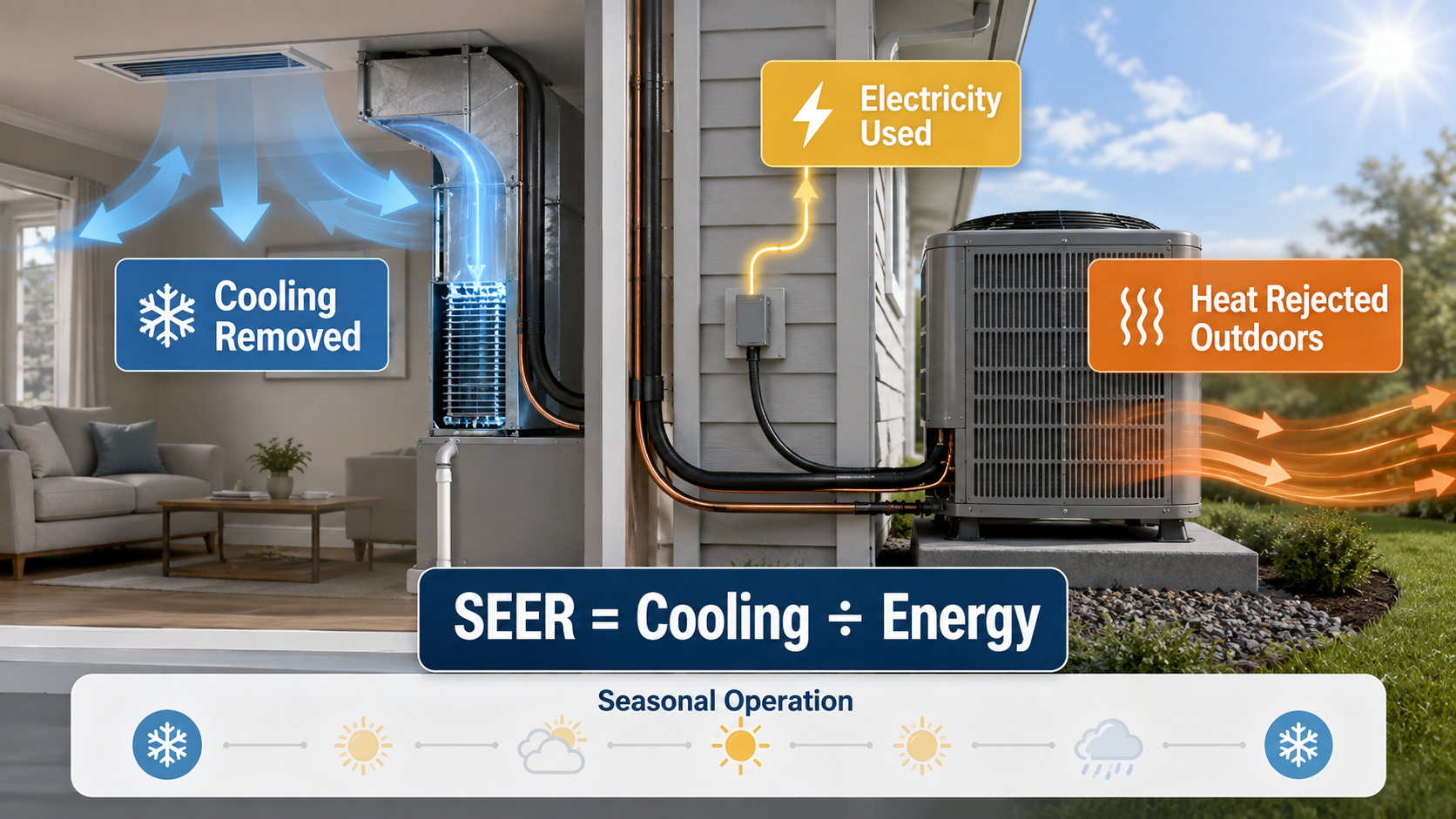
An air conditioner does not create cold. The underlying vapor-compression cycle uses electrical work to move heat from the building to the outdoor environment.
What Does a SEER Rating Mean?
SEER stands for Seasonal Energy Efficiency Ratio. SEER2 is the corresponding seasonal rating determined under the newer federal Appendix M1 test procedure. Both are expressed in Btu per watt-hour, commonly written as Btu/Wh.
- \(\mathrm{SEER}\) Seasonal cooling efficiency in Btu/Wh. The represented value is called SEER2 when it is determined under Appendix M1.
- \(Q_{\mathrm{seasonal}}\) Total heat removed from the conditioned space during the standardized cooling season, in Btu.
- \(E_{\mathrm{seasonal}}\) Total electrical energy consumed by the rated system during the same seasonal calculation, in Wh.
What a Higher SEER Rating Means
When two systems are evaluated under the same rating framework and deliver the same seasonal cooling output, the higher-rated system requires less rated electrical energy. An 18 SEER2 system is therefore more efficient under the standardized procedure than a 15 SEER2 system.
The rating does not describe how much cooling the system can provide at one moment. Cooling capacity and seasonal efficiency answer different questions:
- Cooling capacity is the rate at which the equipment can remove heat, normally expressed in Btu/h or tons of refrigeration.
- SEER2 is seasonal cooling output divided by seasonal electrical energy use.
- Annual energy use depends on the building load, climate, operation, installation, and equipment rating.
What SEER Does Not Measure
A SEER2 rating does not independently show whether equipment is properly sized, how efficiently it operates during the hottest hour of the year, or how much of a home’s total electricity bill comes from cooling.
SEER2 also does not describe heat-pump heating efficiency. Heating decisions require additional information such as HSPF2, condition-specific coefficient of performance, low-temperature capacity, defrost behavior, and supplemental-heat operation.
Use SEER2 to compare certified cooling efficiency. Use a load calculation, matched-system data, installation scope, local electricity cost, and lifecycle economics to decide which system is the better purchase.
Why SEER Is a Seasonal Rating
An air conditioner rarely operates at one outdoor temperature and one cooling load for an entire season. It cycles, stages, or modulates as weather, thermostat settings, solar gains, occupancy, humidity, and internal heat loads change.
The seasonal rating procedure represents performance across defined operating conditions and load behavior. This distinguishes SEER2 from a single test-point efficiency measurement.
Part-Load Operation
Most HVAC systems spend substantial operating time below maximum capacity. Equipment can respond to those reduced loads in different ways:
- Single-stage systems generally operate at one compressor capacity and cycle on and off to match the average building load.
- Two-stage systems can operate at a lower capacity during moderate conditions and shift to a higher stage as the load increases.
- Variable-capacity systems can adjust compressor and fan operation over a wider range, reducing cycling when properly selected and controlled.
A higher SEER2 rating may result from improved heat exchangers, more efficient motors, better controls, compressor staging, or variable-speed operation. The rating alone does not identify which feature produced the improvement.
SEER2 Versus EER2
SEER2 measures seasonal cooling efficiency. EER2 compares the rate of cooling delivered with electrical input at a defined test condition. EER2 can therefore add useful context for performance near a specific operating point, particularly in hot climates with long periods of high cooling demand.
SEER vs. SEER2
SEER2 is not a different physical concept from SEER. Both describe seasonal cooling efficiency. The difference is that SEER2 is the represented value produced under the updated Appendix M1 test procedure.

Because the procedures differ, an older SEER value and a newer SEER2 value should not be treated as though they were produced by the same test. For broadly comparable equipment, the SEER2 number is often numerically lower than the former SEER number.
Why the Test Changed
Installed ducted systems create resistance that the blower must overcome. The updated test method uses revised external static-pressure assumptions intended to better represent installed duct-system resistance for applicable equipment.
Static pressure affects fan power, airflow, coil performance, comfort, and system capacity. The HVAC static pressure guide explains how duct resistance is measured and diagnosed in an operating system.
Can SEER Be Converted Directly to SEER2?
Approximate conversion factors can support a preliminary comparison, but there is no single universal conversion that should replace certified product data. The relationship depends on the equipment configuration and applicable test procedure.
For an equipment purchase, use the certified SEER2 value for the complete matched combination rather than converting an older outdoor-unit marketing rating.
Do not use an old SEER rating and a new SEER2 rating in the same savings calculation unless the conversion method and its limitations are clearly stated.
SEER2, EER2, HSPF2, and COP Compared
HVAC equipment can have several efficiency metrics because seasonal cooling, peak-condition cooling, seasonal heating, and single-condition heating are different performance questions.
| Metric | What It Measures | Units | When It Is Most Useful |
|---|---|---|---|
| SEER2 | Cooling delivered over a standardized cooling season divided by seasonal electrical energy. | Btu/Wh | Comparing the seasonal cooling efficiency of current residential air conditioners and heat pumps. |
| EER2 | Cooling rate divided by electrical input at a defined test condition. | Btu/Wh | Adding performance context at a specific cooling condition. |
| HSPF2 | Seasonal heat supplied by a heat pump divided by seasonal electrical energy under the prescribed heating calculation. | Btu/Wh | Comparing seasonal heat-pump heating efficiency. |
| COP | Useful heating or cooling rate divided by input power at a specific operating condition. | Dimensionless | Evaluating performance at a stated temperature, load, or equipment operating point. |
For a cooling-only air conditioner, SEER2 and EER2 are the most relevant listed efficiency metrics. For a heat pump, also review HSPF2, heating capacity at relevant outdoor temperatures, and condition-specific COP.
The heat pump system guide explains how cooling and heating operation are combined in one refrigeration system.
What Is a Good SEER2 Rating?
A good SEER2 rating is not automatically the highest number available. It is the efficiency level that meets applicable requirements and provides the best combination of installed cost, expected cooling use, comfort, serviceability, and ownership-period value.
Minimum efficiency requirements depend on equipment class, system type, capacity, and other regulatory details. Current Department of Energy requirements and certified equipment data should be used instead of an older national rule of thumb.
| Selection Category | What It Prioritizes | Often Fits | Main Decision Question |
|---|---|---|---|
| Minimum-compliant | Lower initial cost while meeting applicable efficiency requirements. | Lower cooling use, shorter ownership periods, or projects with strict capital limits. | Will lower initial cost outweigh the estimated increase in operating cost? |
| Balanced efficiency | A moderate installed-cost premium with improved seasonal efficiency and comfort features. | Many full-time residences with meaningful cooling demand and a normal ownership horizon. | Do the energy and comfort benefits justify the incremental installed price? |
| Premium efficiency | Higher seasonal efficiency, wider modulation, reduced cycling, or advanced comfort control. | High cooling use, high electricity prices, long ownership, or projects prioritizing comfort and sound. | Will the system run enough—and be installed well enough—to realize the premium? |
These categories are decision aids rather than formal regulatory classifications. Compare actual certified model combinations and complete installed proposals instead of assuming that every system with the same SEER2 rating offers identical controls, sound, warranty, or service requirements.
Minimum Efficiency Versus Best Value
Minimum-compliant equipment can be a rational choice when annual cooling use is low, the ownership period is short, or the efficiency upgrade is unusually expensive.
Higher-efficiency equipment becomes more attractive when the system operates frequently, electricity is expensive, the ownership period is long, and the installation preserves the rated performance.
Comfort Versus Efficiency
Two systems with different SEER2 ratings may also differ in staging, minimum operating capacity, airflow control, dehumidification behavior, sound, thermostat compatibility, and control logic.
Those features can improve comfort, but they should be evaluated separately from the seasonal efficiency number. A higher rating does not guarantee quieter operation, better humidity control, or simpler maintenance.
SEER2 Energy Savings Comparison
For a preliminary comparison, assume two systems deliver the same amount of seasonal cooling and that both ratings use the same test framework. Under those assumptions, seasonal electricity use is inversely proportional to the efficiency rating.
- \(\mathrm{SEER2}_{\mathrm{baseline}}\) Certified seasonal rating of the baseline system.
- \(\mathrm{SEER2}_{\mathrm{proposed}}\) Certified seasonal rating of the proposed system under the same rating framework.
Quick Savings Comparisons
These simplified comparisons assume equal seasonal cooling output and two SEER2-rated systems:
- 14.3 to 16 SEER2: approximately 10.6% lower rated cooling electricity use.
- 15 to 18 SEER2: approximately 16.7% lower rated cooling electricity use.
- 16 to 20 SEER2: approximately 20% lower rated cooling electricity use.
- 18 to 22 SEER2: approximately 18.2% lower rated cooling electricity use.
The percentage gain becomes progressively smaller for equal numerical increases at higher ratings. Moving from 14 to 16 produces a larger proportional improvement than moving from 20 to 22.
Worked SEER2 Example
Suppose a homeowner compares a 15 SEER2 system with an 18 SEER2 system. Assuming equal seasonal cooling output:
The higher-rated system would use approximately 16.7% less cooling electricity under the simplified comparison. That is not a 16.7% reduction in the entire utility bill because cooling is only one portion of total household energy use.
If the baseline system is estimated to use 3,000 kWh per year for cooling, the simplified comparison gives:
At an assumed electricity rate of $0.16 per kWh, the estimated annual cooling-cost reduction is:
If the 18 SEER2 proposal costs $2,000 more, the simple payback based only on this estimate would be approximately 25 years. A hotter climate, higher electricity rate, greater cooling load, incentive, or smaller price premium would shorten that payback. Lower use or poor installation would lengthen it.
Why Real Savings Differ
- The building may require more or less cooling than the estimate assumes.
- The existing system may no longer perform at its original rating.
- Duct leakage and attic heat gain can increase delivered cooling losses.
- Humidity control and fan operation can change total electricity use.
- Thermostat settings, occupancy, shading, and weather vary by year.
- Variable-capacity equipment savings depend on how the system operates at part load.
Use this ratio for a screening comparison, not as a replacement for a building load calculation, equipment-performance model, or measured energy analysis.
How to Choose the Right SEER2 Rating
Start with the building and expected operation rather than choosing a rating from a product brochure. The best value depends on how much the equipment will run, what the efficiency upgrade costs, and whether the system will be installed and commissioned correctly.

- Calculate the building load: Use an appropriate residential or commercial load calculation rather than selecting capacity from floor area alone.
- Estimate annual cooling use: Consider climate, thermostat settings, occupancy, insulation, windows, shading, humidity, and duct location.
- Compare matched systems: Request the outdoor-unit, indoor-coil, air-handler, or furnace model numbers and verify the certified combination.
- Identify the price premium: Compare the incremental installed cost of the efficiency upgrade, not just the total price of two dissimilar proposals.
- Estimate annual savings: Use consistent SEER2 values, local electricity prices, and realistic cooling-energy assumptions.
- Review comfort features: Compare staging, minimum capacity, airflow control, dehumidification, sound, controls, and thermostat compatibility.
- Review installation quality: Confirm duct, airflow, charging, condensate, electrical, control, startup, and commissioning requirements.
Questions to Ask Before Paying More
- How many hours is the cooling system likely to operate each year?
- What is the installed-price difference between the proposed options?
- Are the capacities similar, or are the proposals based on different sizing assumptions?
- Are both ratings for the complete matched equipment combination?
- Does the higher-rated system include variable-capacity or comfort features that matter to the building?
- Will the existing ducts allow the required airflow without excessive static pressure?
- How long is the owner likely to keep the equipment?
- Are repair costs, proprietary controls, and local parts availability acceptable?
HVAC Quote Efficiency Verification Checklist
- Outdoor-unit model number
- Indoor coil or air-handler model number
- Furnace and blower match, when applicable
- Certified SEER2 and EER2 values for the complete combination
- HSPF2 and low-temperature heating data for heat pumps
- Design cooling and heating loads
- Proposed cooling and heating capacities
- Duct leakage, repair, sealing, and insulation scope
- Required airflow and available static-pressure capability
- Refrigerant charging and verification procedure
- Thermostat and staging compatibility
- Startup and commissioning documentation
Compare the incremental cost of each efficiency step with the incremental energy, comfort, and control benefit. The highest-rated system is not automatically the best system, and the lowest-priced system is not automatically the lowest-cost system to own.
How Equipment Size and System Type Affect the Decision
Efficiency selection should happen after the building load and proposed system type are understood. An efficient system that is oversized, poorly matched, or inappropriate for the building can deliver disappointing comfort and energy performance.
Correct Equipment Sizing
A cooling-load calculation estimates how much heat the HVAC system must remove under design conditions. The calculation considers the envelope, windows, orientation, infiltration, ventilation, occupancy, internal loads, and climate.
The HVAC load calculation guide explains the major inputs and why floor-area rules alone are unreliable. For a preliminary estimate, the HVAC load calculator can help organize the main assumptions.
Different HVAC System Types
SEER2 commonly appears on residential central air conditioners and heat pumps below the applicable capacity threshold. Larger commercial equipment may use other metrics such as IEER, depending on the equipment class and regulatory framework.
Before comparing ratings, confirm that the proposed systems perform the same job. A conventional split system, packaged unit, ductless system, and variable refrigerant system can differ in distribution losses, zoning, installation requirements, controls, and maintenance.
The types of HVAC systems guide compares the major configurations and where each is commonly used.
Do not compare two ratings without checking equipment class, capacity, system configuration, test framework, and whether both systems serve the same building load.
Why Actual Efficiency Can Be Lower Than the Rating
SEER2 is a standardized equipment comparison. The installed HVAC system operates inside a specific building with real ducts, controls, weather, maintenance conditions, and occupant behavior. Problems in any of those areas can reduce useful cooling or increase electrical consumption.
- Oversized equipment: Frequent cycling can reduce humidity control, increase temperature swings, and prevent staged or variable equipment from operating efficiently.
- Undersized equipment: The system may run continuously during design conditions and still fail to maintain the intended indoor temperature.
- Incorrect equipment match: The outdoor unit, indoor coil, blower, and metering device may not produce the advertised rating when combined incorrectly.
- Low airflow: Dirty filters, restrictive ducts, closed registers, incorrect blower setup, or a dirty coil can reduce capacity and alter refrigerant conditions.
- Duct leakage: Supply leakage loses conditioned air, while return leakage can draw hot, humid, dusty, or unconditioned air into the system.
- Incorrect refrigerant charge: Undercharging or overcharging can reduce capacity, increase compressor stress, and lower efficiency.
- Poor control setup: Incorrect staging, fan delays, thermostat configuration, or sensor placement can cause unnecessary cycling or inefficient operation.
- Dirty heat-transfer surfaces: Fouled indoor and outdoor coils increase thermal resistance and can raise compressor power.
- Extreme operating conditions: Actual temperatures and loads can differ substantially from the standardized conditions represented by a seasonal rating.
Equipment Rating Versus Whole-System Performance
The equipment label describes a rated combination under a prescribed test method. Whole-system performance also includes the building envelope, duct distribution, control sequence, installation details, and maintenance condition.
Replacing an outdoor condenser does not repair a leaking attic duct, correct an oversized system, or guarantee proper airflow through the indoor coil. A lower-rated system with excellent design and installation can outperform a higher-rated system that is poorly matched or commissioned.
How Controls Affect Efficiency
Controls determine when compressors, fans, stages, dampers, and auxiliary heat operate. Incorrect staging logic or thermostat configuration can prevent higher-efficiency equipment from operating as intended.
Review the HVAC controls guide to understand thermostats, sensors, sequences, actuators, and building automation functions.
The certified rating belongs to a tested or represented equipment combination—not to the outdoor cabinet by itself. Verify the indoor and outdoor model combination before accepting a quoted SEER2 value.
How to Find and Verify a SEER2 Rating
Do not rely solely on a large efficiency number printed on a proposal or outdoor-unit brochure. A split-system rating depends on the combination of indoor and outdoor components.
- Record every model number: Identify the outdoor unit, indoor coil or air handler, and furnace or blower when applicable.
- Check the EnergyGuide information: Use the label as consumer comparison information while confirming that it applies to the proposed configuration.
- Review manufacturer performance data: Confirm capacity, SEER2, EER2, airflow requirements, sound data, and operating limits.
- Verify the matched combination: Use certified system data, such as the applicable AHRI directory listing or certificate supplied by the contractor.
- Confirm the installed configuration: Coil orientation, metering device, blower setup, controls, and accessories must match the conditions required for the represented rating.
Where to Look
- Equipment proposal: The proposal should list complete model numbers rather than a general product family.
- EnergyGuide label: This provides standardized consumer efficiency and operating-cost information for covered products.
- Manufacturer submittal: Detailed data can identify the rated combination and required airflow.
- AHRI certificate or directory: Certified combination data can confirm that the indoor and outdoor components achieve the represented rating.
- Commissioning record: Field measurements should confirm airflow, charging, temperature response, controls, and safe operation.
Air Conditioners Versus Heat Pumps
An air conditioner uses SEER2 to describe seasonal cooling efficiency. A heat pump also uses SEER2 for cooling mode, but heating performance requires additional data.
Review HSPF2, heating capacity at relevant outdoor temperatures, COP, defrost behavior, and supplemental-heat requirements. A heat pump with strong cooling efficiency may not necessarily have the best low-temperature heating performance.
Common SEER Rating Misconceptions
Higher SEER Means More Cooling Capacity
Incorrect. Capacity describes how quickly equipment removes heat. SEER2 describes seasonal cooling efficiency. Two systems can have the same capacity and different efficiency ratings.
The Highest Rating Always Saves the Most Money
The highest rating may use the least cooling electricity, but it can still have a weak financial return when the price premium is large or annual cooling use is low.
The Outdoor-Unit Rating Is the System Rating
Split-system performance depends on the indoor coil, outdoor unit, blower, metering device, and tested combination. The outdoor model alone does not establish the installed-system rating.
SEER2 Predicts the Exact Utility Bill
SEER2 is a standardized comparison metric. Actual energy use depends on weather, building load, thermostat settings, ducts, installation, maintenance, and occupant behavior.
SEER2 Measures Heat-Pump Heating Efficiency
SEER2 describes cooling performance. Heat-pump heating requires HSPF2 and condition-specific heating-capacity and COP data.
New Equipment Fixes Existing Duct Problems
New equipment does not seal leaking ducts, reduce excessive static pressure, correct poor return-air design, or add missing insulation. Those problems require separate work.
SEER and SEER2 Engineering References
These official sources support the definitions, test-method context, efficiency metrics, and equipment-selection guidance used on this page.
- U.S. Department of Energy: Purchasing Energy-Efficient Residential Central Air Conditioners Supports SEER2 purchasing context, lifecycle-cost considerations, EnergyGuide use, equipment sizing, duct condition, refrigerant charge, and installation-quality guidance.
- ENERGY STAR: Air-Source Heat Pump Key Product Criteria Supports formal definitions of SEER2, EER2, HSPF2, COP, split systems, packaged equipment, and matched heat-pump systems.
- Electronic Code of Federal Regulations: 10 CFR Part 430 Subpart B Provides the federal test-procedure framework for central air conditioners and heat pumps, including Appendix M1 and represented SEER2 values.
Frequently Asked Questions
A 16 SEER rating means the represented seasonal cooling output is 16 Btu for each watt-hour of represented seasonal electrical consumption. It is an efficiency ratio, not the equipment’s cooling capacity and not a guarantee of a specific annual utility cost.
A higher SEER2 rating indicates better certified seasonal cooling efficiency, but it is not always the best financial choice. Value depends on climate, cooling hours, electricity price, installed-cost premium, ownership period, equipment features, and installation quality.
SEER and SEER2 both describe seasonal cooling efficiency, but SEER2 is determined under the updated Appendix M1 test procedure. The revised method changed test assumptions, including external static pressure for many ducted systems, so the values should not be treated as identical.
Not precisely. Approximate conversions can support an initial comparison, but certified SEER2 data for the actual matched equipment combination is more reliable. Avoid using old SEER and new SEER2 values in the same savings formula without a stated conversion assumption.
No. SEER2 describes cooling-mode efficiency. Heat-pump heating decisions should also consider HSPF2, COP, heating capacity at relevant outdoor temperatures, defrost operation, and expected supplemental-heat use.
Summary and Next Steps
A SEER rating compares seasonal cooling output with seasonal electrical consumption. SEER2 applies the updated Appendix M1 test method and is the appropriate certified cooling-efficiency metric for comparing current residential air conditioners and heat pumps.
Use the rating as one part of the decision. Verify the matched equipment, calculate the building load, compare realistic annual savings with the installed-price premium, and review airflow, ducts, charging, controls, and commissioning. A high rating cannot compensate for poor system design or installation.
Where to Go Next
-
HVAC Load Calculation
Determine the heating and cooling loads that should guide system capacity before comparing equipment efficiency.
-
Heat Pump System
Understand how heat pumps provide both cooling and heating and which additional efficiency metrics matter.
-
HVAC Static Pressure
Learn how duct resistance and airflow affect fan power, comfort, capacity, and installed performance.