Mechanical Engineering Salary

Salary ranges, entry-level pay, senior pay, industry differences, career growth, and practical offer checks for mechanical engineers.

By Turn2Engineering Editorial Team Updated June 10, 2026 10 min read

Key Takeaways

  • Core idea: Mechanical engineering salary is best understood as a range because pay changes with role level, industry, location, specialization, credentials, and total compensation.
  • Current benchmark: U.S. mechanical engineers have a median annual wage of $102,320 and a median hourly wage of $49.19 based on May 2024 wage data.
  • What controls it: Experience, industry, technical depth, location, PE licensure, leadership scope, and business impact determine where an engineer lands inside the salary range.
  • Practical check: A strong offer should be judged against local market pay, role responsibility, technical growth, benefits, bonus potential, and promotion path.
Table of Contents

    Introduction

    Mechanical engineering salary describes the pay range for engineers who design, analyze, build, test, and improve mechanical and thermal systems. In the United States, the median mechanical engineer earns about $102,320 per year, but real pay depends heavily on experience, industry, location, specialization, credentials, and whether the role includes leadership or high-value technical ownership.

    Mechanical Engineering Salary Snapshot

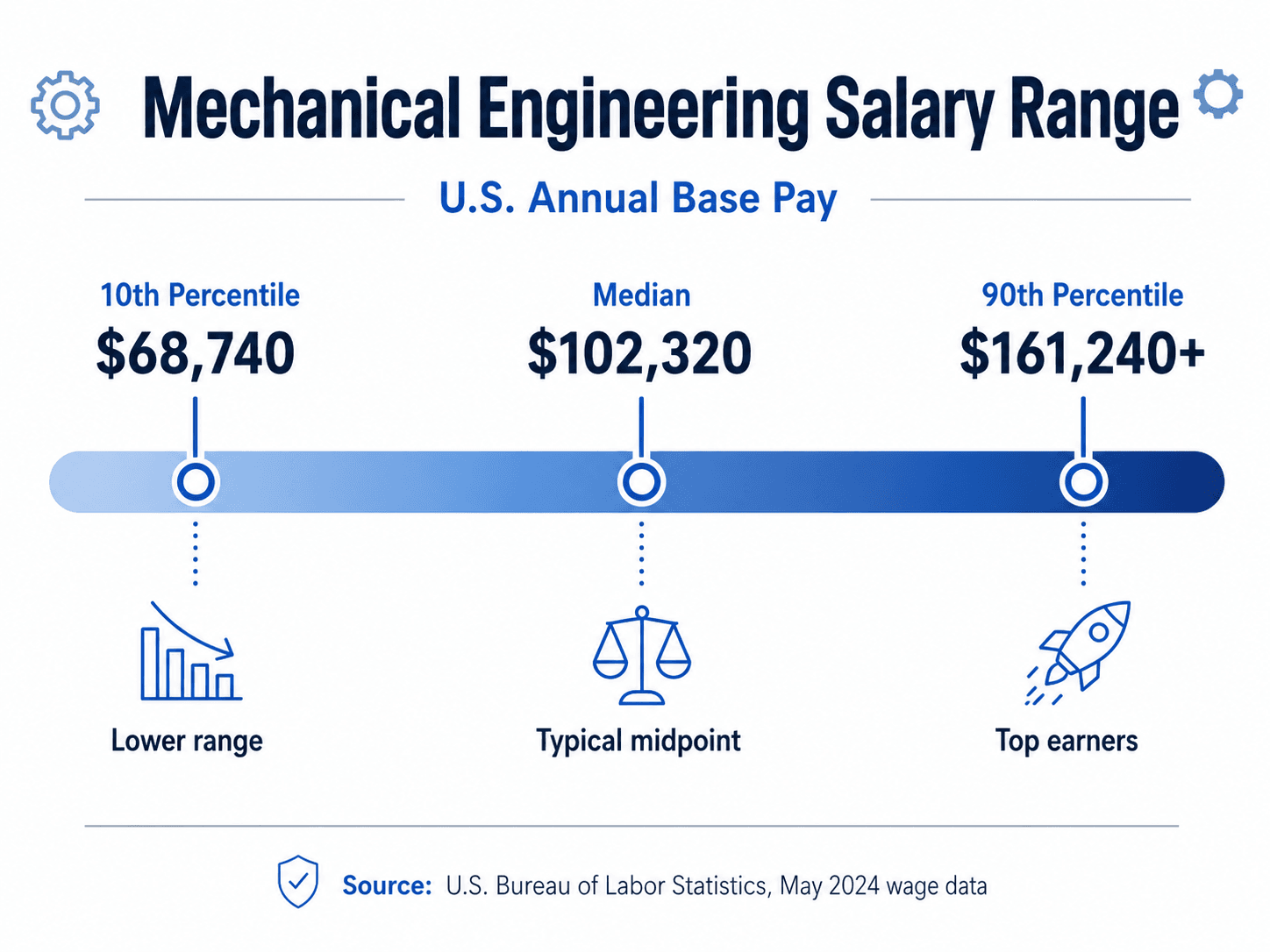
    The most useful starting point is the national wage distribution. The median salary gives a reliable midpoint, while the 10th and 90th percentiles show how wide the profession can be once experience, region, industry, and responsibility are included.

    Salary metricValueHow to use it
    Median annual salary$102,320Best single national benchmark for a typical U.S. mechanical engineer.
    Median hourly wage$49.19Useful for comparing hourly roles, contract work, overtime, and salary-to-hourly conversions.
    Lowest 10 percentLess than $68,740Lower-range benchmark; not a perfect entry-level number because region and job type matter.
    Highest 10 percentMore than $161,240Upper-range benchmark often associated with senior responsibility, leadership, or premium industries.
    Job outlook9 percent growth, 2024–2034Indicates demand is projected to grow much faster than the average for all occupations.
    Salary interpretation

    A national median is a benchmark, not a job offer target. A fair salary depends on the actual role: CAD support, product design, test engineering, manufacturing support, HVAC consulting, aerospace analysis, automation, or engineering management can all fall under the mechanical engineering umbrella.

    Mechanical Engineering Salary Range at a Glance

    Mechanical engineering salary range infographic showing lower range, median salary, and top earner salary levels for U.S. mechanical engineers
    Mechanical engineering salary is a distribution. The median is the best single benchmark, while the lower and upper percentiles help frame early-career offers, regional variation, and high-paying senior or specialized roles.

    Start with the median, then adjust for the job’s actual scope. A design engineer supporting drawings, a senior engineer leading subsystem validation, and a principal engineer owning a product architecture should not be compared as if they are the same job.

    What Is Mechanical Engineering Salary?

    Mechanical engineering salary is the compensation paid to engineers who apply mechanics, materials, thermodynamics, fluids, manufacturing, controls, testing, and design principles to real products and systems. It may include base salary, hourly pay, bonus, profit sharing, stock, overtime, relocation, retirement match, and benefits.

    The key challenge is that mechanical engineering is broad. One engineer may design machine components, another may analyze thermal loads, another may support manufacturing, and another may manage HVAC design for buildings. Because the field spans many industries, salary data must be interpreted by role function, not just job title.

    Salary termWhat it meansWhy it matters
    Median salaryThe midpoint where half of workers earn more and half earn less.Usually the cleanest benchmark for typical pay.
    Average salaryThe arithmetic mean of all reported salaries.Can be pulled upward by senior engineers, managers, and high-paying industries.
    Percentile salaryA point in the wage distribution, such as the 10th, 50th, or 90th percentile.Useful for understanding lower-range, typical, and upper-range compensation.
    Total compensationBase pay plus bonus, stock, overtime, profit sharing, retirement match, and benefits.Two offers with the same base salary can have very different real value.
    Engineering salary check

    The same title can mean very different work. “Mechanical Engineer II” at a manufacturing plant may focus on production support, while the same title at an aerospace company may involve analysis, qualification testing, and design ownership for safety-critical hardware.

    Mechanical Engineering Salary by Experience Level

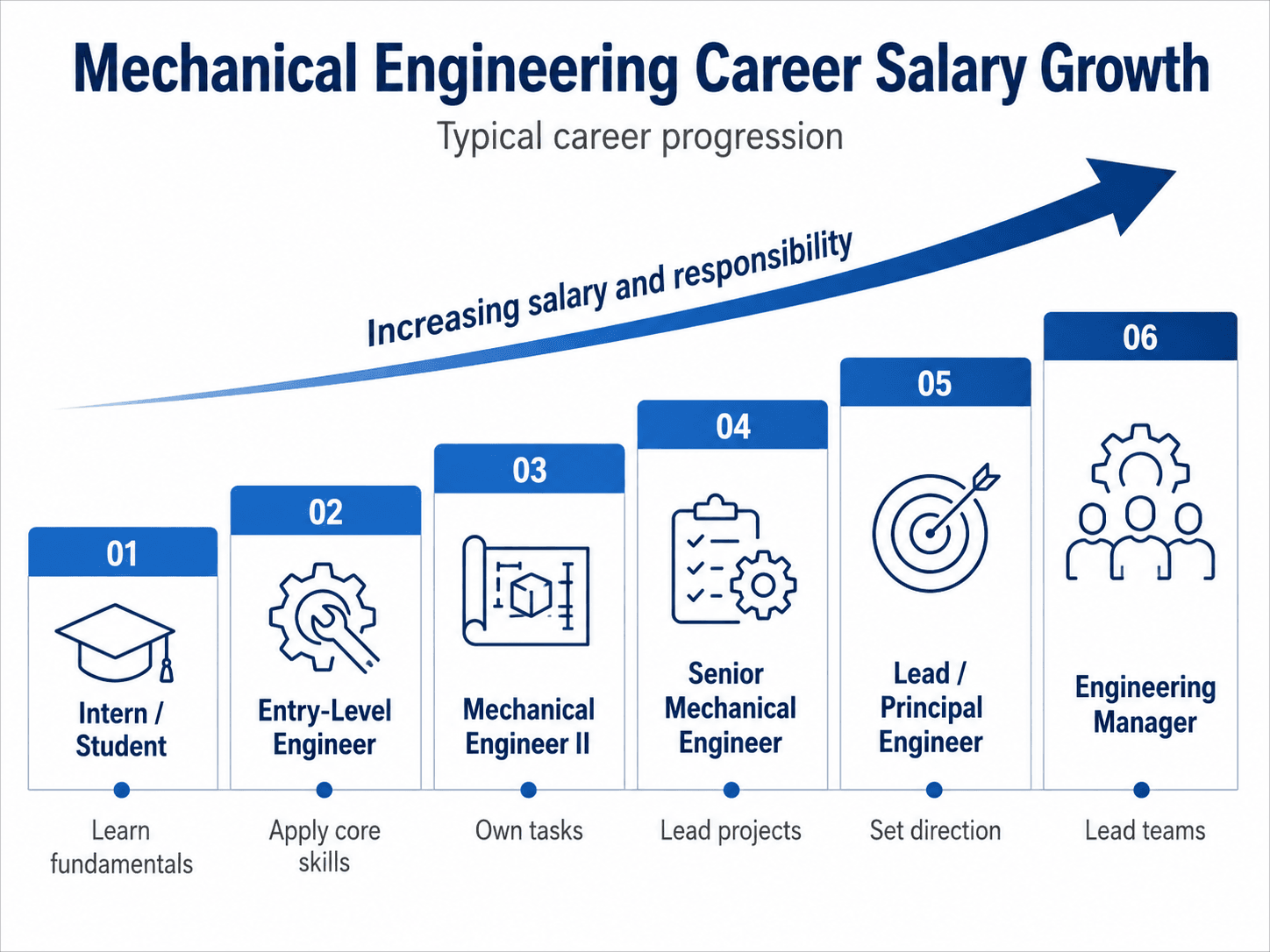
    Salary usually rises as the engineer moves from task execution to technical ownership. Early roles tend to focus on learning tools, standards, drawings, test procedures, and company processes. Higher-paying roles usually involve decisions that affect cost, safety, reliability, schedule, suppliers, customers, and product performance.

    Mechanical engineering career salary growth chart showing progression from intern and entry-level engineer to senior engineer, principal engineer, and engineering manager
    Mechanical engineering salary tends to grow as responsibility shifts from learning and task support to project ownership, technical direction, specialization, and leadership.
    Career stageTypical salary interpretationWhat usually drives higher pay
    Intern or co-opUsually hourly or temporary, often used as a pipeline into full-time engineering work.Hands-on exposure to CAD, test labs, manufacturing, documentation, and real engineering teams.
    Entry-level mechanical engineerOften below the national median, with pay varying heavily by city, industry, internships, and technical role scope.Strong fundamentals, internship experience, CAD ability, communication, and willingness to learn real design and test practices.
    Mechanical Engineer IIOften moves closer to the national median when the role includes real design, analysis, testing, or manufacturing ownership.Independent task ownership, supplier coordination, problem solving, and fewer review cycles needed from senior engineers.
    Senior mechanical engineerOften reaches six figures, especially in strong markets, premium industries, or technically demanding roles.Design reviews, mentoring, root-cause analysis, subsystem ownership, cost reduction, and risk management.
    Lead, principal, or staff engineerCan move toward upper-percentile compensation when the engineer influences multiple projects or product lines.System-level judgment, architecture decisions, technical strategy, failure prevention, and cross-functional influence.
    Engineering managerCan exceed individual contributor pay, but the job shifts toward people, budgets, schedules, and business accountability.Team leadership, hiring, planning, customer alignment, project delivery, and executive-level communication.

    Why entry-level salary is not the same as the 10th percentile

    The 10th percentile is useful for understanding the low end of the national wage distribution, but it is not the same thing as an entry-level salary. It can include lower-cost regions, lower-paying industries, unusual roles, part-time work, or jobs with limited engineering scope. Entry-level candidates should compare offers against local Engineer I postings, industry norms, internship experience, and the actual work being performed.

    Can Mechanical Engineers Make $100,000 or More?

    Yes. Mechanical engineers can make six figures, and the national median salary is already slightly above $100,000. However, many entry-level engineers start below that level, while experienced engineers, senior engineers, principal engineers, engineering managers, and specialists in high-value industries can move well above it.

    Path to six figuresWhy it worksWhat to build
    Senior technical contributorSenior engineers are paid for judgment, review quality, and the ability to solve expensive problems.Design ownership, analysis depth, testing experience, and failure prevention.
    High-value industryIndustries with expensive failures or complex hardware often pay more for strong mechanical judgment.Aerospace, defense, energy, electronics, automation, robotics, and advanced manufacturing skills.
    Engineering managementManagers are paid for team output, project delivery, budgets, schedules, and business impact.Communication, planning, coaching, prioritization, and cross-functional leadership.
    PE-focused consulting pathLicensure can add value where engineers sign, seal, supervise, or provide services to the public.HVAC, facilities, utilities, building systems, codes, client management, and project delivery.
    Practical career insight

    The fastest route to stronger pay is rarely just “more years.” Salary growth usually comes from building judgment that other people trust: reviewing designs, catching failure risks, improving manufacturability, leading tests, coordinating suppliers, or making decisions that protect cost, quality, and schedule.

    Mechanical Engineering Salary by Industry

    Industry is one of the biggest salary drivers because it changes the value of the engineering work. A design mistake in a low-volume prototype, an aircraft subsystem, an industrial automation line, and a consumer product may have very different consequences. Pay tends to rise when engineering decisions affect safety, reliability, production uptime, regulatory approval, energy performance, or high-value hardware.

    Industry or employer typeWhy pay can be strongerMechanical engineering skills that matter
    Scientific research and developmentOften involves advanced products, prototypes, testing, modeling, and high-value technical uncertainty.Experimental design, modeling, test planning, data analysis, prototyping, and technical documentation.
    Computer and electronic product manufacturingMechanical work may support high-value hardware, cooling, packaging, precision assemblies, and production systems.Thermal management, CAD, DFM, electronics packaging, reliability, supplier quality, and manufacturing process control.
    Aerospace and defenseHigh reliability expectations, qualification testing, safety-critical design, and configuration control can increase compensation.Stress analysis, fatigue, thermal analysis, materials, tolerances, systems thinking, and design review discipline.
    Transportation equipment manufacturingAutomotive, rail, heavy equipment, and mobility roles often involve durability, cost, testing, safety, and production constraints.Vehicle systems, manufacturing, testing, materials, design validation, quality, and root-cause analysis.
    Engineering services and consultingPay depends on client responsibility, licensure, project size, billable value, and the ability to deliver reliable designs.HVAC, fluids, heat transfer, project coordination, codes, commissioning, and PE licensure path.
    Machinery manufacturingCompensation varies widely but can be strong when the engineer owns complex machine design or production-critical equipment.Machine design, bearings, shafts, gears, fasteners, manufacturing drawings, tolerances, and field support.
    Robotics and automationAutomation work can pay well when mechanical design improves throughput, reliability, labor efficiency, or plant uptime.Mechanisms, actuators, sensors, controls coordination, machine guarding, tolerances, and production troubleshooting.

    A mechanical engineer who combines design ability with analysis, testing, manufacturing knowledge, and communication usually has more salary leverage than one who only produces drawings. The market pays for decisions that reduce risk and create measurable value.

    Highest-Paying Mechanical Engineering Skills and Career Paths

    Mechanical engineers increase earning power by developing skills that solve expensive problems. The most valuable skills tend to connect technical depth with business impact: fewer failures, faster validation, lower manufacturing cost, better uptime, improved safety, and stronger product performance.

    Skill or pathWhy it can increase payUseful next step
    FEA and stress analysisSupports strength, stiffness, fatigue, failure prevention, and design validation for expensive or safety-critical parts.Study stress analysis fundamentals.
    Thermal analysis and heat transferValuable in HVAC, electronics cooling, energy systems, aerospace, combustion, refrigeration, and battery systems.Review heat transfer concepts.
    Mechanical design ownershipEngineers who own parts, assemblies, interfaces, tolerances, and design reviews create more project value.Build mechanical design knowledge.
    Design for manufacturingReduces scrap, rework, supplier problems, assembly issues, and production delays.Learn manufacturing processes, tolerance stackups, inspection methods, and supplier feedback loops.
    Failure analysis and reliabilityPrevents repeated failures, warranty cost, downtime, safety issues, and customer dissatisfaction.Study failure mechanisms.
    Automation and roboticsImproves productivity, uptime, labor efficiency, and manufacturing throughput.Build strength in mechanisms, sensors, actuators, safety, machine design, and controls coordination.
    Project leadershipMoves the engineer closer to budgets, schedules, customers, suppliers, and business outcomes.Practice technical communication, risk tracking, design review leadership, and cross-functional coordination.

    What Drives a Mechanical Engineer’s Salary?

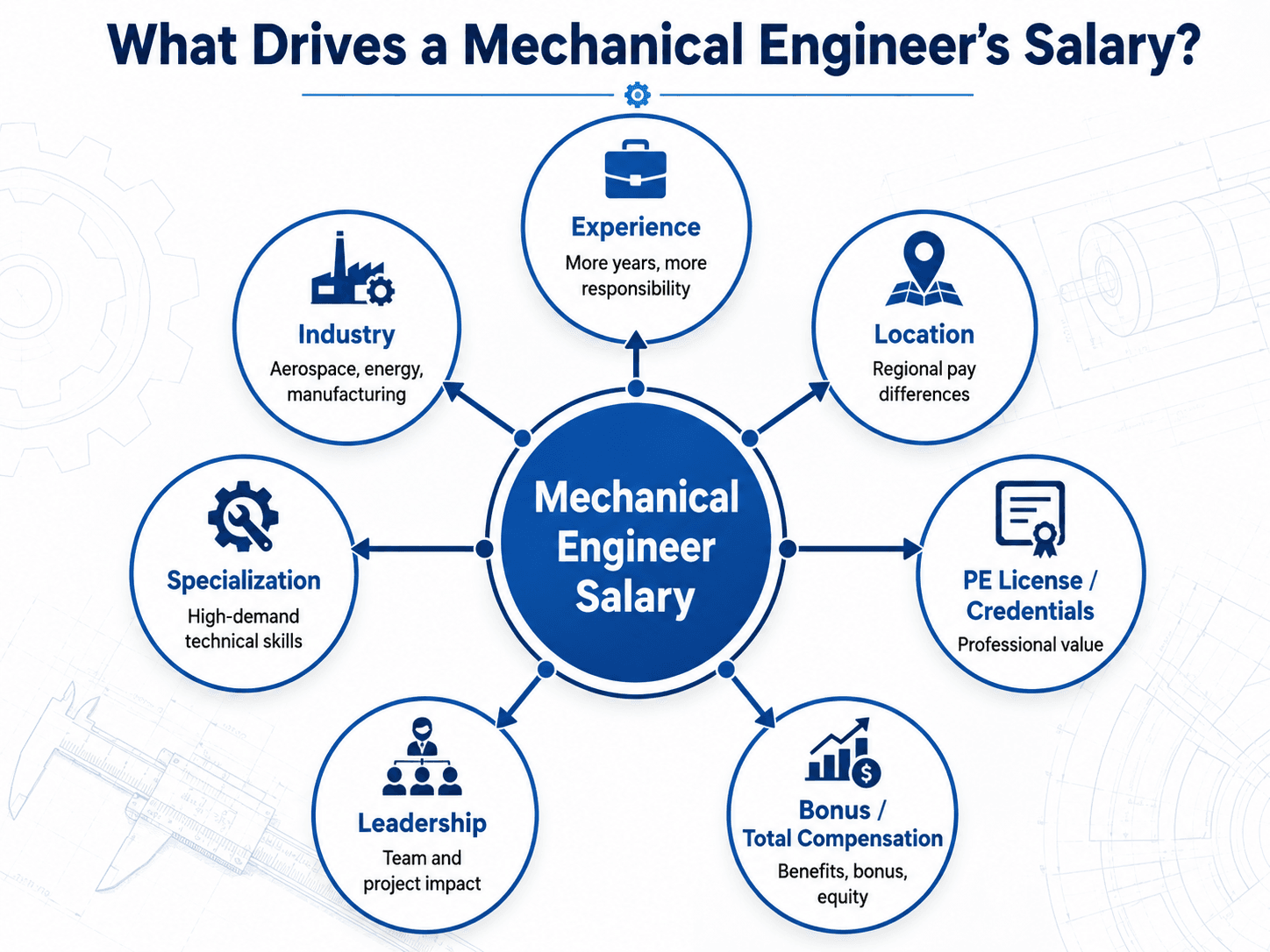
    Mechanical engineering salary is controlled by a combination of market factors and engineering value. Location and industry set the market range, but responsibility, specialization, and business impact determine where an engineer falls within that range.

    Diagram showing factors that drive mechanical engineering salary including experience, industry, specialization, location, PE license, leadership, and total compensation
    Mechanical engineer pay is influenced by experience, industry, specialization, region, credentials, leadership responsibility, and total compensation beyond base salary.
    Salary driverWhy it mattersPractical implication
    Experience levelExperienced engineers are expected to solve ambiguous problems and reduce design risk.Pay increases fastest when experience turns into independent ownership, not just time served.
    IndustryDifferent industries assign different value to reliability, uptime, certification, speed, and technical risk.Aerospace, R&D, energy, automation, and high-value hardware may pay more than commodity product support roles.
    LocationSalary bands reflect local labor markets, cost of living, employer density, and competition for engineering talent.A high salary in a high-cost metro may not be stronger than a lower salary in a lower-cost region.
    SpecializationRare or high-demand skills create leverage when they solve expensive problems.FEA, thermal analysis, manufacturing automation, robotics, controls coordination, and reliability can improve earning power.
    PE license and credentialsLicensure matters most where engineers sign, seal, supervise, or provide engineering services to the public.The PE path can be especially valuable in consulting, HVAC, facilities, utilities, and public-facing engineering work.
    Leadership and communicationSenior engineers are often paid for judgment, influence, and cross-functional execution.Engineers who explain risk, defend decisions, mentor others, and align teams often move into higher compensation bands.
    Total compensationBase salary does not capture bonus, stock, profit sharing, overtime, travel pay, retirement match, and benefits.A lower base salary may still be competitive if total compensation and growth path are strong.

    Mechanical Engineering Salary by Location

    Location changes both salary and buying power. Mechanical engineers in high-cost labor markets may see larger base salaries, but housing, taxes, transportation, and commuting can reduce the practical value of that pay. Lower-cost regions may show lower salaries while still offering strong real income.

    Location comparisonWhat it usually showsHow to interpret it
    U.S. national benchmarkBest broad baseline for mechanical engineering pay across all regions.Use the national median first, then adjust for city, industry, and role level.
    Large engineering metrosMay offer higher salaries because more employers compete for specialized engineering talent.Compare salary against housing, commute time, taxes, and quality of technical opportunities.
    Dallas-Fort Worth and Texas marketsCan be attractive for engineering, energy, manufacturing, aerospace, construction, and industrial employers.Use local postings and employer data because DFW, Houston, Austin, San Antonio, and smaller Texas markets can differ significantly.
    Manufacturing regionsMay offer strong practical engineering experience even when base salaries are below high-cost coastal metros.Consider whether the role builds design, test, production, quality, automation, or reliability skills.
    High-cost coastal metrosOften show higher base salary ranges, especially in hardware, aerospace, electronics, and advanced technology roles.Do not compare base salary alone; compare real take-home value and long-term career growth.

    Remote and hybrid work

    Remote work is less common for hands-on test, plant support, field, manufacturing, and lab roles, but hybrid work can exist for CAD, analysis, documentation, project engineering, and some product development positions. Salary may still be anchored to the employer’s location, the employee’s location, or an internal geographic pay band.

    Offer comparison tip

    Compare salary offers after adjusting for commute, cost of living, bonus potential, benefits, career growth, and the kind of engineering experience the role will build. A slightly lower offer can be better if it gives stronger technical ownership and a clearer path to senior roles.

    Why Salary Websites Show Different Numbers

    Mechanical engineering salary numbers often differ because each source measures a different slice of the market. A government wage survey, a job board, an employer review site, and a compensation modeling platform may all be useful, but they should not be treated as interchangeable.

    Source typeWhat it measuresBest useCaution
    BLS government wage dataOccupation-level wage data by employment, industry, state, and metro area.Best baseline for national salary, hourly wage, percentiles, and job outlook.May not capture specific employer offers, bonuses, stock, or the most recent hiring pressure.
    Self-reported salary platformsSalary profiles submitted by users or inferred from compensation data.Useful for employer-specific, title-specific, and location-specific comparisons when sample size is strong.Can be affected by sample bias, title mismatch, and total-pay vs base-pay confusion.
    Job boardsCurrent job postings, posted ranges, and sometimes user-submitted salary information.Useful for active hiring-market signals and local offer expectations.Posted ranges may be broad, incomplete, inflated, or not directly comparable to total compensation.
    Compensation modeling sitesEstimated ranges based on job level, geography, employer type, and compensation surveys.Useful for career-stage ranges and HR-style benchmarking.May not match a specific role’s technical scope or hiring urgency.

    The best approach is to triangulate. Use BLS data to understand the broad profession, local postings to understand current hiring demand, employer-specific sources to understand company pay bands, and the actual job description to determine whether the salary matches the responsibility.

    Is Mechanical Engineering a Good-Paying Career?

    Mechanical engineering is generally a strong-paying career because it combines broad industry demand with technical problem solving that affects cost, safety, reliability, productivity, and product performance. The profession also has a wide career ceiling because engineers can move into senior technical roles, project leadership, engineering management, consulting, product development, automation, energy, aerospace, or high-value manufacturing.

    Career factorWhy it supports earning potentialPractical note
    Broad industry demandMechanical engineers work across manufacturing, energy, aerospace, robotics, HVAC, electronics, transportation, and product development.The broad field gives flexibility, but salary depends on choosing roles that build valuable technical judgment.
    Projected employment growthMechanical engineering employment is projected to grow faster than the average for all occupations.Demand does not guarantee high pay in every role; specialization and impact still matter.
    Technical career ladderEngineers can grow from entry-level work into senior, principal, staff, lead, or management roles.Higher pay usually comes with ownership of decisions, risk, systems, people, or business outcomes.
    Transferable fundamentalsMechanics, materials, fluids, thermodynamics, manufacturing, and design transfer across many industries.Engineers who keep learning can pivot into stronger markets over time.

    Mechanical Engineering Salary Compared With Other Engineering Fields

    Mechanical engineering salaries are competitive, but the field is broad. Some mechanical roles pay less than software-heavy or electronics-heavy jobs, while specialized mechanical roles in aerospace, energy, automation, R&D, or high-value hardware can be very strong. The best comparison is not discipline versus discipline, but responsibility, industry, location, and skill scarcity.

    ComparisonTypical salary patternPractical interpretation
    Mechanical vs. civil engineeringMechanical engineering may offer higher pay in manufacturing, aerospace, energy, and advanced hardware roles.Civil engineering salary can be strong in consulting, infrastructure, management, and PE-driven career paths.
    Mechanical vs. electrical engineeringElectrical engineering may pay more in semiconductors, power electronics, controls, and technology hardware markets.Mechanical engineers can close the gap by building thermal, mechatronics, robotics, or hardware product skills.
    Mechanical vs. aerospace engineeringAerospace roles can pay well but may be concentrated in specific regions and employers.Mechanical engineers can often enter aerospace through structures, thermal, propulsion support, mechanisms, or manufacturing roles.
    Mechanical vs. manufacturing engineeringManufacturing engineering salaries vary widely by plant, process, automation level, and industry.Mechanical engineers with automation, process improvement, and production troubleshooting skills can be highly valuable.

    Mechanical Engineer Job Offer Sanity Check

    A salary offer should not be judged by base pay alone. Mechanical engineering roles build different kinds of career capital. A job that teaches strong design review, test planning, manufacturing support, supplier management, and analysis may be more valuable long term than a role with slightly higher pay but little technical growth.

    Practical workflow

    First, compare the offer to the local market and role level. Next, review the technical scope: design ownership, analysis depth, testing responsibility, production exposure, and mentorship. Then evaluate total compensation, benefits, work schedule, commute, and promotion path. Finally, ask whether the role builds skills that move you toward higher-value mechanical engineering work.

    Offer checkStrong signalWeak signal
    Base salaryCompetitive for the city, industry, role level, and responsibility.Below local market without clear upside, training, benefits, or promotion path.
    Engineering scopeIncludes design decisions, testing, analysis, manufacturing input, or technical ownership.Mostly drafting, paperwork, repetitive updates, or low-value support with limited learning.
    Mentorship and reviewAccess to experienced engineers, design reviews, lessons learned, and structured feedback.Little technical guidance, unclear standards, or no one qualified to review your work.
    Total compensationBase salary plus meaningful benefits, bonus, retirement match, training, or paid overtime where applicable.Base salary looks acceptable but benefits, bonus, work hours, and growth path are weak.
    Career directionThe role builds skills in design, analysis, manufacturing, automation, HVAC, energy, reliability, or project leadership.The role does not build transferable technical judgment or future salary leverage.

    Example offer comparison

    Consider two early-career offers. Offer A pays $82,000 in a lower-cost manufacturing region and includes test work, design reviews, supplier exposure, and mentorship from senior engineers. Offer B pays $92,000 in a high-cost metro but is mostly documentation support with limited technical ownership. Offer B has the higher base salary, but Offer A may build stronger long-term salary leverage if it develops practical design and troubleshooting judgment.

    Senior engineer check

    A good mechanical engineering role should make you better at solving real problems. If the work never exposes you to loads, materials, tolerances, testing, failure modes, cost, quality, manufacturing, or customers, the salary may be less valuable than it appears.

    Salary Negotiation Tips for Mechanical Engineers

    Salary negotiation works best when it is grounded in evidence and role value. Instead of saying only that you want more money, connect the request to market data, the role’s responsibility, your technical experience, and the business value you can create.

    Negotiation pointHow to frame itWhy it helps
    Market benchmarkReference national salary data, local job postings, and comparable role levels.Shows the request is based on the labor market, not a random number.
    Role scopeClarify design ownership, test responsibility, supplier coordination, analysis work, or production impact.Higher responsibility should be evaluated differently than routine support work.
    Technical evidencePoint to internships, projects, CAD/FEA work, manufacturing experience, testing, or measurable results.Connects compensation to useful engineering capability.
    Total compensationAsk about bonus, overtime, relocation, training, retirement match, benefits, and promotion timing.Improves the offer even when base salary flexibility is limited.
    Current employee raiseTie the request to cost savings, fewer failures, faster testing, quality improvements, or successful project ownership.Managers are more likely to support raises when the value is specific and measurable.
    Negotiation reality

    Early-career engineers often have limited leverage on base salary, but they can still negotiate start date, relocation, review cycle, training, hybrid schedule, bonus eligibility, or a clear path to promotion after demonstrated performance.

    Engineering Judgment and Field Reality

    Salary data is clean; engineering careers are not. Two mechanical engineers with the same title may have very different responsibilities. One may be maintaining legacy drawings, while another is making design decisions that affect testing, safety, production cost, customer delivery, and warranty risk.

    Field reality also matters. Mechanical engineers who understand how parts are manufactured, assembled, inspected, tested, installed, and maintained can make better decisions than engineers who only see the CAD model. That practical judgment often separates routine support roles from higher-paying technical ownership roles.

    Field reality

    The market tends to reward engineers who prevent expensive problems before they reach production or the field. Salary growth is often strongest when an engineer becomes trusted to catch weak assumptions, unclear requirements, tolerance issues, thermal risks, manufacturing problems, and failure modes before they become costly.

    When Salary Benchmarks Break Down

    Salary benchmarks are helpful, but they break down when the job title hides the actual work. “Mechanical engineer” can describe design, analysis, project engineering, manufacturing support, field engineering, sales engineering, facilities engineering, quality, test, reliability, or management.

    • Title mismatch: A role called “mechanical engineer” may be mostly CAD drafting, manufacturing support, project coordination, or deep technical analysis.
    • Location mismatch: National salary data may not reflect local cost of living, employer density, or regional industry clusters.
    • Industry mismatch: Commodity manufacturing, consulting, aerospace, energy, electronics, and automation can have very different pay structures.
    • Total compensation mismatch: Bonus, overtime, stock, profit sharing, healthcare, retirement match, and travel requirements can change the real value of an offer.
    • Experience mismatch: A ten-year engineer with narrow task experience may not be paid like a ten-year engineer who owns complex systems and mentors others.

    Common Salary Research Mistakes

    Mechanical engineering salary research often goes wrong when readers compare numbers without context. A national median, a job posting, a self-reported salary profile, and an employer-specific range may all be useful, but they answer different questions.

    • Using one salary website as the whole market: One source may understate or overstate pay depending on sample size, location, and reporting method.
    • Comparing base salary to total compensation: A job with bonus, overtime, stock, or strong benefits may be better than a job with a slightly higher base salary.
    • Ignoring the role’s technical growth: Early-career engineers should consider whether the role builds valuable design, analysis, test, manufacturing, and troubleshooting skills.
    • Assuming high-cost cities are automatically better: Higher base pay may be offset by housing, taxes, commute time, or weaker work-life balance.
    • Treating percentiles as career stages: A percentile is a wage distribution point, not a precise label for entry-level, mid-career, or senior roles.
    Common mistake

    Do not compare your offer to the national median without adjusting for city, industry, experience level, technical scope, and total compensation. A fair offer in one market can be weak or strong in another.

    Salary Data Sources and Career References

    Mechanical engineering salary pages should use a stable, authoritative data source for baseline wage and job outlook information. For U.S. readers, the most useful public reference is federal occupational wage and employment data.

    • U.S. Bureau of Labor Statistics: BLS Occupational Outlook Handbook for Mechanical Engineers covers national median pay, hourly wage, job outlook, education requirements, common duties, work environment, industry wage differences, and state or area wage data for mechanical engineers.
    • Project-specific interpretation: Salary numbers should still be adjusted for local market, industry, employer size, role level, total compensation, and the kind of engineering responsibility the job actually includes.
    • Engineering use: Use salary data as a benchmark, then evaluate whether the role builds valuable mechanical engineering judgment through design, analysis, testing, manufacturing, field support, or leadership.

    Frequently Asked Questions

    Mechanical engineers in the United States earn a median annual wage of $102,320 based on May 2024 wage data. Actual pay varies by experience, location, industry, specialization, credentials, and total compensation structure.

    Yes. Mechanical engineers can make six figures, and the national median salary is already slightly above $100,000. Entry-level engineers often start below that level, while senior engineers, principal engineers, managers, and specialists in high-value industries can earn well above it.

    A good entry-level mechanical engineering salary depends on the city, industry, employer, internship experience, and technical scope of the role. The BLS 10th percentile is a useful lower-range benchmark, but it should not be treated as the exact entry-level salary for every market.

    Higher-paying mechanical engineering work is often found in scientific research and development, computer and electronic product manufacturing, aerospace and defense, transportation equipment, energy, robotics, automation, and specialized consulting.

    Salary websites often use different datasets. Government wage surveys, employer-reported data, self-reported profiles, job postings, and recruiter estimates can all produce different salary numbers even when they use the same job title.

    Summary and Next Steps

    Mechanical engineering salary is best understood as a range shaped by role level, industry, location, technical specialization, credentials, leadership, and total compensation. The national median is a useful benchmark, but it should not be the only number used to judge a job offer or career path.

    The strongest salary growth usually comes from moving beyond task execution into accountable engineering decisions. Mechanical engineers who can solve difficult problems, reduce design risk, improve manufacturability, lead testing, diagnose failures, and communicate across teams tend to build more long-term salary leverage.

    Where to go next

    Continue your learning path with related Turn2Engineering resources.

    Scroll to Top